
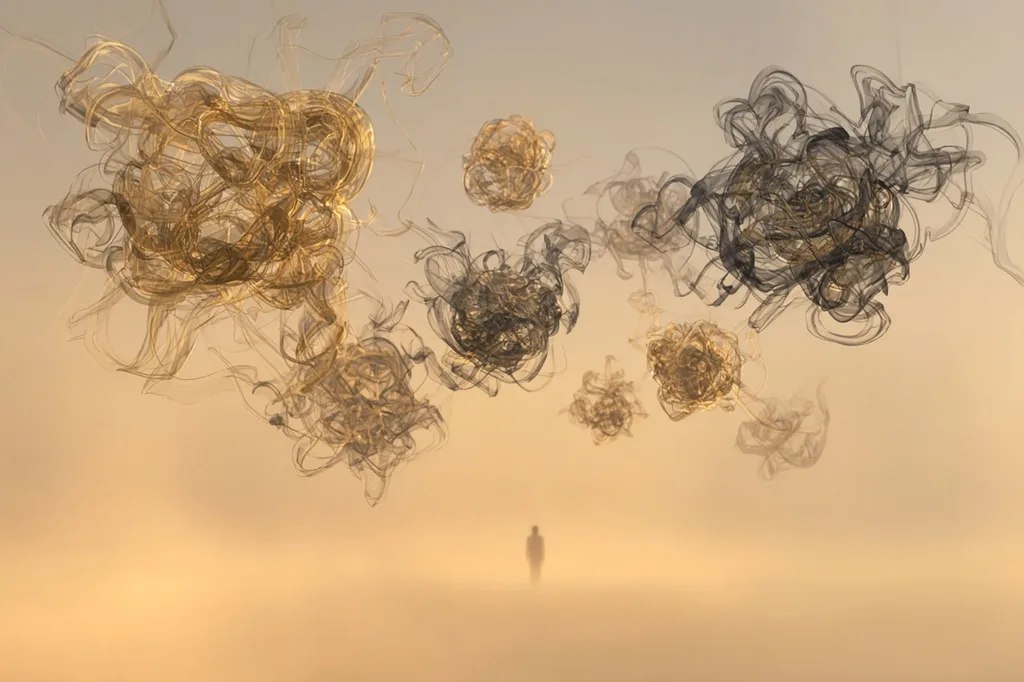
Not everything that happens in our heads works for us. Some thoughts help us understand the world, make decisions, and catch our mistakes. But there are others: they occupy attention, drain energy, push us toward the same reactions again and again — and give almost nothing back. It is convenient to call such thoughts, beliefs, emotional loops, and behavior patterns parasites of consciousness. Not because some creatures have moved into the brain, but because the logic of how they work is strikingly similar to biological parasitism: they live at the host's expense, they are good at disguising themselves as something useful, they change the host's behavior in ways that keep them alive, and sometimes they get passed on — from person to person.
This article is an analytical model, not a medical classification. There are no diagnoses here, and "parasite" is a metaphor for a stable thinking pattern that consumes resources and undermines autonomy. The metaphor is useful exactly to the extent that it helps us notice mechanisms, and we will keep it on a short leash: where it works, where it breaks, and where real research stands behind it. It is worth reading this alongside the guides to critical thinking, to the architecture of beliefs, and to what people do with information.
Key takeaways
A parasite of consciousness is a functional concept, not a content-based one. The same thought can be useful in one life and parasitic in another. What matters is not the topic, but what the thought does to attention, decisions, and the capacity to change.
There are three levels that should not be confused. Biological parasites are real organisms that influence animal behavior. Cognitive parasites are stable mental constructs within a single person. Memetic parasites are ideas and formats that spread between people. The first level is biology; the other two are a model.
The main sign of a parasite is an asymmetric exchange. It takes attention, time, and emotional energy, and gives back an illusion — of understanding, control, being right, or belonging.
Parasites disguise themselves as virtues. Outrage looks like civic engagement, fear like prudence, superiority like critical thinking, false certainty like clarity of mind.
They rarely live alone. Confirmation, belonging, fear, and superiority tend to form a closed loop in which each element feeds the others.
Nobody necessarily designed them. Many parasitic patterns arise as a side effect of the environment: a feed optimized for engagement, a market that sells anxiety, or a group where doubt is expensive.
Intelligence does not necessarily suffer at the level of ability. More often, what erodes is attention, flexibility, the quality of questions, and authorship of decisions — things intelligence tests barely measure.
Immunity is not total distrust. Hyperskepticism becomes a parasite itself: someone who believes nothing is defenseless against whoever offers the most convenient explanation.
The most dangerous parasites don't make you think wrongly. They take away your ability to decide for yourself what is right.
Three levels: biological, cognitive, memetic
To keep the metaphor from turning into mysticism, let's start where parasites exist literally.
The biological level: real organisms, real behavior
Nature has parasites that change their host's behavior in ways that benefit the parasite. The most frequently cited examples sound like the plot of a horror film, but they are described in the scientific literature.
Fungi of the genus Ophiocordyceps infect ants, and an infected ant leaves the colony, climbs to a particular height, clamps its jaws onto a leaf or stem, and dies there — in a spot from which the fungus's spores disperse conveniently. The horsehair worm, a parasitic nematomorph, develops inside crickets and grasshoppers, and in its late stage infected insects more often end up near water, where the worm emerges and continues its life cycle. The trematode Leucochloridium makes a snail's eyestalks look like pulsating caterpillars, attracting birds — its next hosts.
Toxoplasma gondii comes up especially often. Its life cycle completes in cats, with rodents serving as intermediate hosts. In experiments, infected rats and mice are worse at avoiding the smell of cats — that is, they behave in a way that raises the parasite's chances of reaching its final host. Many people are also infected with toxoplasma, and plenty of loud headlines have grown up around that. Caution is needed here: research on links between toxoplasma and human behavior is mostly correlational, the results are inconsistent, and there is no rigorous evidence that the parasite "controls" people.
We need the biology here for one principle: an organism can act in a way that benefits not itself but whatever lives inside it — and not notice the substitution.
The cognitive level: stable mental constructs
A cognitive parasite is not an organism but a pattern: a thought, belief, emotional loop, or habitual reaction that has taken root in the psyche and reproduces itself over and over. It lives off the same resources that thinking runs on: attention, working memory, time, emotional energy. And like its biological counterpart, it tends to change the host's behavior in ways that preserve it: it makes the host seek confirmation, avoid scrutiny, and return to the same stimuli.
An important difference from biology: there is no foreign agent. A cognitive parasite is built from our own mechanisms — heuristics, emotions, social needs. These are not broken parts but normal tools that, under certain conditions, have started working against their owner. A tendency to notice threats used to save lives; in an information environment where threats are served around the clock, the same tendency can eat life up.
The memetic level: ideas that travel
In The Selfish Gene, Richard Dawkins proposed the word "meme" for a unit of cultural transmission — a tune, a phrase, a custom, an idea that is copied from person to person and competes with others for space in minds. The key idea to take from this is very simple: an idea spreads not because it is true or useful, but because it copies well. Truth can help it spread, or it may not.
A memetic parasite is an idea or format that transmits well but serves poorly the people who carry it. A chain letter threatening misfortune to anyone who fails to forward it is an almost laboratory-grade example: the content is useless, but a copying mechanism and a penalty for stopping it are built in. Modern equivalents are more sophisticated: a rumor you "urgently need to show your family," or a theory that declares everyone who doubts it part of the conspiracy. Memetics never became a rigorous discipline — a "meme" as a unit is hard to define, and ideas get distorted and blended along the way — so we use it as a lens, not as a theory with precise laws.
How the levels connect
A memetic parasite, once it gets into a head, becomes cognitive; a cognitive one, once a person starts broadcasting it, becomes memetic. But neither is a "creature" in the brain, and a claim like "an entity lives inside you" is no longer analysis — it is mystification.
What makes a thought a parasite?
The metaphor immediately creates a dangerous temptation: to declare any thought we dislike a parasite. Someone else's ideology is a parasite; ours is a conviction. To avoid this, we need a definition that doesn't depend on a thought's content and applies equally to our own views and other people's.
The proposed criterion is functional: a thought works like a parasite when it persistently consumes resources without proportionate benefit, and at the same time reduces a person's ability to examine it or let it go. Both parts matter. Heavy thoughts about a loved one's illness consume a lot of resources, but they are not parasitic if they help you act. And a light, habitual thought can be a parasite if it quietly switches off scrutiny.
| Criterion | Healthy thought | Parasitic thought |
|---|---|---|
| Resource exchange | Spends attention and returns understanding, a decision, or an action | Takes attention and returns a feeling — of being right, anxiety, pleasure — without changing the situation |
| Recurrence | Comes back when there is new information or a task | Comes back on its own, in circles, regardless of new data |
| Attitude to scrutiny | Allows the question "what if I'm wrong?" | Makes that question unpleasant, dangerous, or "disloyal" |
| Disguise | Calls itself what it is | Passes itself off as a virtue: principle, prudence, clarity |
| Effect on field of view | Widens it: you notice more options | Narrows it: one or two answers and one type of stimulus remain |
| Self-replication | Doesn't demand to be defended and spread | Pushes you to seek confirmation and pass it on |
| Authorship | Feels like a conclusion you reached | Feels like something obvious that "arrived on its own" |
No single criterion proves parasitism on its own. A recurring thought may simply be important; an emotionally charged one may be justified. The signal is the combination: the thought comes back on its own, tolerates scrutiny poorly, narrows your field of view, and presents itself as a virtue.
Why parasites hide so well
Parasites of consciousness share one property that makes them especially resilient: they are embedded in the feeling "this is just what I think." Daniel Kahneman described fast, automatic thinking that produces impressions and intuitions effortlessly, and slow thinking that is able to check them but engages reluctantly. Parasites almost always live in the fast circuit. They don't look like arguments that can be weighed; they look like perception itself: "it's obvious," "everyone thinks so," "that's dangerous," "they're like that."
Kahneman also described a tendency he called "what you see is all there is": the mind builds a coherent story out of the available data and doesn't notice what's missing. A parasite doesn't need to fake facts. It is enough to control what enters the field of view — the mind will build a confident picture on its own. This mechanism is explored in detail in the piece on learning to see the hole, not the donut: noticing what is absent is harder than noticing what is present.
The psychologist and researcher Steven Hayes, creator of acceptance and commitment therapy, uses the term "cognitive fusion": a state in which a person looks not at a thought but from inside it, taking it as a direct reflection of reality. In a state of fusion, the thought "I'm a failure" is not a hypothesis but a fact. A parasite needs fusion to survive: as long as the thought is indistinguishable from you, it can't be examined — and so it can't be let go.
A catalog of parasites of consciousness
Below are the ten most common parasites. This is not an exhaustive classification but a working catalog: for each one — what it feeds on, how it disguises itself, what it does to thinking, and where its weak spot is. Each creature has its own form: the silhouette should explain the mechanism. Many of them rest on well-studied cognitive biases, but the parasite metaphor adds an important angle: not just "a thinking error," but a pattern that sustains itself.
The confirmation parasite
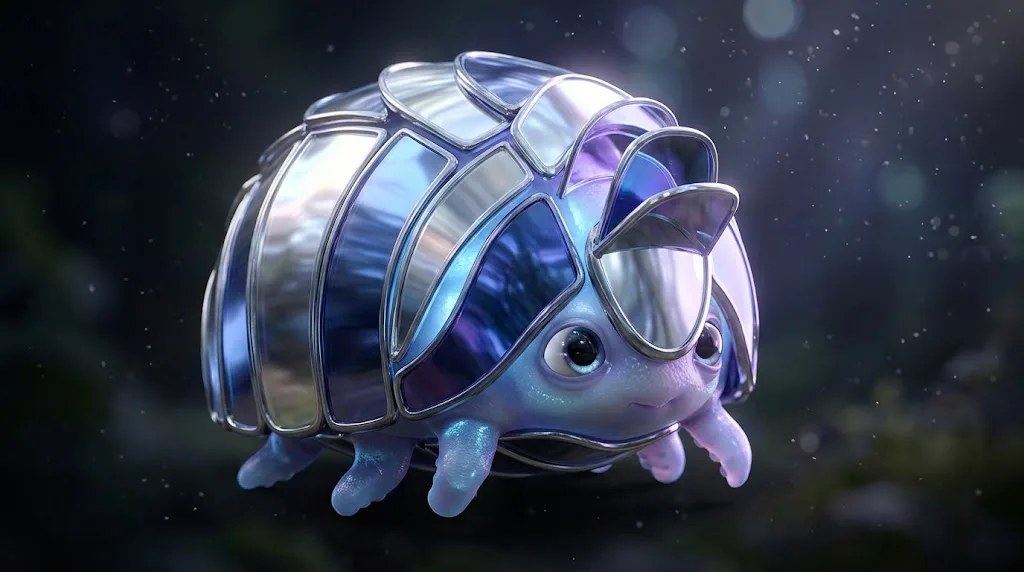
Form: echo crystal. A polyhedral body of mirrored facets that grows only where light strikes at an already familiar angle. A beam from another side goes dark without a trace.
Anatomical quirk: the more identical reflections it gathers, the larger the crystal — and the less surface remains for foreign light.
What it feeds on: any signal that matches an opinion you already hold.
Confirmation bias is one of the most studied cognitive biases. People more readily seek out, notice, and remember information that supports their view, and scrutinize information that contradicts it more harshly. This isn't conscious dishonesty: the filter works quietly and feels like ordinary attentiveness.
Confirmation becomes a parasite when it turns into a closed feeding system. The person no longer merely prefers agreeable sources — they build an environment in which there are no dissenters. Each new piece of "evidence" delivers a small dose of satisfaction: "I told you so." The belief grows fatter but not smarter: the number of confirmations rises while the quality of scrutiny falls.
Disguise: "I've just read a lot on this topic." The volume read really is large — but it is the same thing read from different angles.
What it destroys: the ability to update your views. If there is a ready answer to every refutation and every coincidence counts as proof, the belief stops being a hypothesis about the world and becomes a substitute for it. More on how belief nodes defend themselves in the guide to the architecture of beliefs.
Weak spot: the question "what would change my mind?" If it can't be answered, that in itself is information.
The outrage parasite
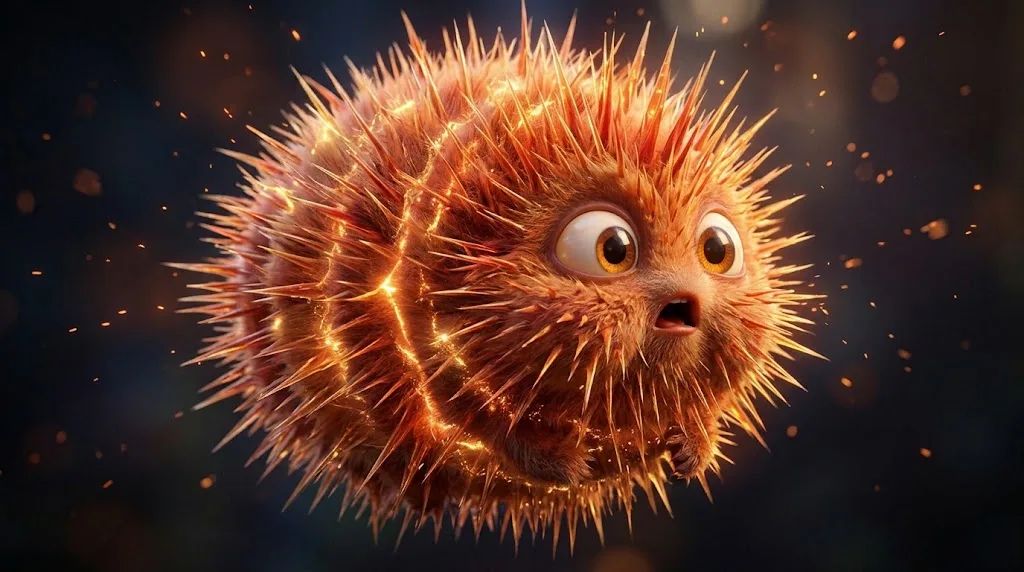
Form: rage bellows. A leather bellows with a glowing core: every moral spark pumps air in, the body swells and vents heat that draws new sparks.
Anatomical quirk: it cannot deflate gradually — only in jerks. At rest the bellows still twitches, hunting the next pretext.
What it feeds on: moral indignation — your own and other people's.
Outrage is a powerful social emotion. It signals a violation of norms and mobilizes a group against the violator, and in that sense it serves an important function: without the capacity to be outraged by injustice, many reforms would never have happened. The trouble starts when outrage stops being a reaction to an event and becomes a mode of existence.
The information environment has created ideal conditions for this. Platforms that rank content by engagement inevitably promote what provokes strong reactions, and moral indignation is one of the most reliable reactions there is. Studies of how social media posts spread show that messages with moral-emotional language travel further, especially within politically homogeneous groups. Nobody had to plan this: all it takes is an algorithm that learns from clicks and people who click on what stings them.
The outrage parasite is effective because it gives its host three rewards at once: a sense of moral righteousness, a feeling of belonging to the "right" side, and a release of tension. In return it takes attention, which drains into an endless feed of violations, and the ability to see complexity. An outraged person cannot simultaneously be angry at an opponent and understand the opponent's motives — these are different modes of operation.
George Orwell's novel 1984 has the ritual of the "Two Minutes Hate" — a daily session of collective fury against the enemy. This is literature, not science, but the image captures the mechanism precisely; the modern feed simply does without a schedule and supplies occasions continuously.
Disguise: civic engagement, caring, "staying silent is not an option."
What it destroys: proportion. When every day brings a new reason for rage, the scale disappears: the petty and the monstrous provoke the same reaction, which means neither gets the reaction it deserves.
Weak spot: the question "what am I going to do about this?" Outrage that leads to action is a tool. Outrage that leads only to the next post is feed.
The superiority parasite
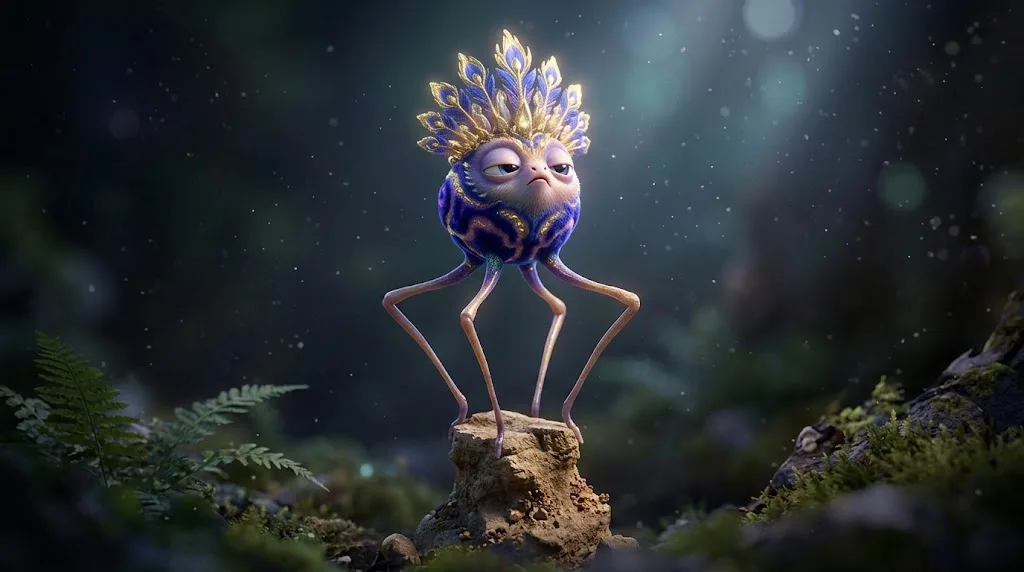
Form: lookout tower. A narrow creature on a single strut with a long eyestalk always aimed down and aside — at “them.” The foot barely touches shared ground.
Anatomical quirk: the taller the stalk, the worse the tower sees its own base. The blind spot grows with height.
What it feeds on: the feeling that you understand more than others.
This is a subtle parasite, and it is especially fond of people who consider themselves critical thinkers. Its formula: "I see what they don't." Sometimes that's true. But the superiority parasite makes the feeling permanent and independent of facts: your own position is assumed in advance to be more thought-through, and others' to be naive, brainwashed, or self-serving.
Psychologists have described several mechanisms it relies on. Emily Pronin and colleagues demonstrated the "bias blind spot": people easily spot biases in others and poorly in themselves. Leonid Rozenblit and Frank Keil described the "illusion of explanatory depth": people feel they understand how things work — from zippers to political programs — until they are asked to explain the mechanism step by step. The illusion of understanding and confidence in other people's stupidity complement each other perfectly.
This parasite is most dangerous in educated circles, where knowledge of cognitive biases becomes not a tool for checking but a weapon: "that's just your confirmation bias." Critical thinking aimed only outward turns into a status game.
Disguise: critical thinking, intellectual honesty, "I'm just calling things by their names."
What it destroys: the ability to learn. Someone who is sure in advance that they understand more stops asking questions — above all, of themselves. In The Scout Mindset, Julia Galef contrasts soldier mindset, which defends a position, with scout mindset, which wants to see the terrain as it is; there is a breakdown in our book summary. The superiority parasite is a soldier dressed as a scout.
Weak spot: trying to state your opponent's position so that they would agree with it themselves. If you can't, your understanding is smaller than it seemed.
The fear parasite
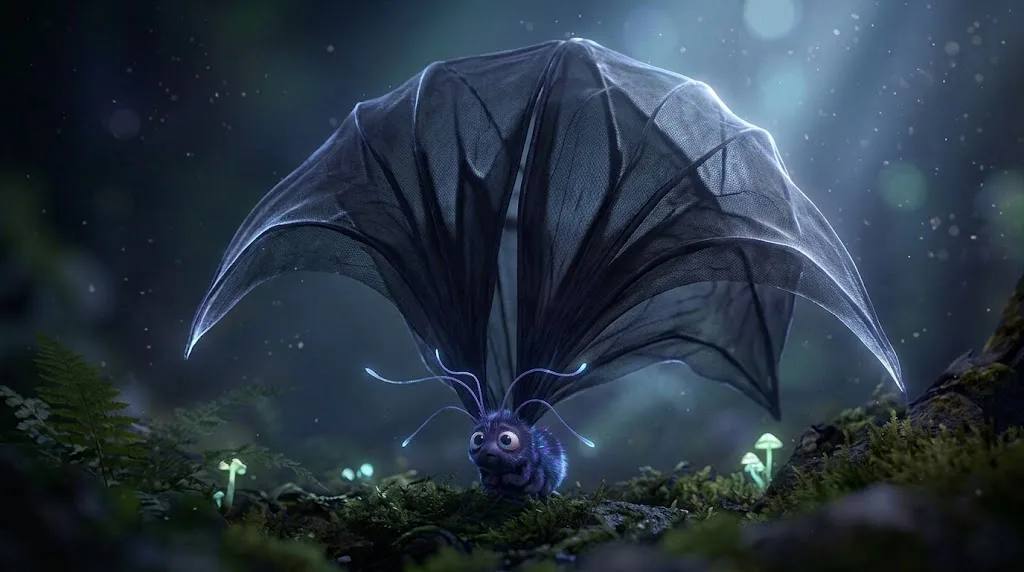
Form: shadow projector. A small dense body casting a huge flickering cone of shadow: a tiny threat throws a predator silhouette across the whole wall.
Anatomical quirk: the more often a bright “news” beam switches on, the larger and less stable the shadow — even if the object itself has not changed.
What it feeds on: threats — real, possible, and imagined.
Fear is an ancient and useful system tuned to err on the side of caution: it is cheaper to be startled by a shadow ten times than to miss a predator once. When threats were local, this worked; now that alarming news is available from all over the planet, the setting starts working against us.
Kahneman and Amos Tversky described the availability heuristic: we judge the probability of an event by how easily examples of it come to mind. Vivid, frightening, repeatedly shown events come to mind more easily — and seem more likely than they are. The fear parasite exploits this directly: it doesn't need to lie about probabilities; it only needs to show the same thing often and vividly.
In Influence, Robert Cialdini describes scarcity as one of the principles that raise the value of something in our eyes: what we might lose seems more important. Fear of loss drives an enormous number of sales, political campaigns, and scams. "Only three spots left," "if you don't act now," "they're already coming for your children" — these are versions of the same lever at different scales.
The most insidious property of the fear parasite is that it narrows thinking. Under threat, attention focuses on the source of danger, and careful consideration of options feels like an unaffordable luxury. A frightened person tends to choose whoever offers a simple, decisive action — even if the action is bad. How fear is used in mass communication is examined in detail in the article on how propaganda works.
Disguise: prudence, realism, "better safe than sorry."
What it destroys: the ability to weigh things. Fear makes one threat enormous and blocks out the others — including the threats created by the panicked decision itself.
Weak spot: questions about base rates and the cost of action. "How likely is this, really?" and "What do I lose if I do what my fear is suggesting?"
The belonging parasite
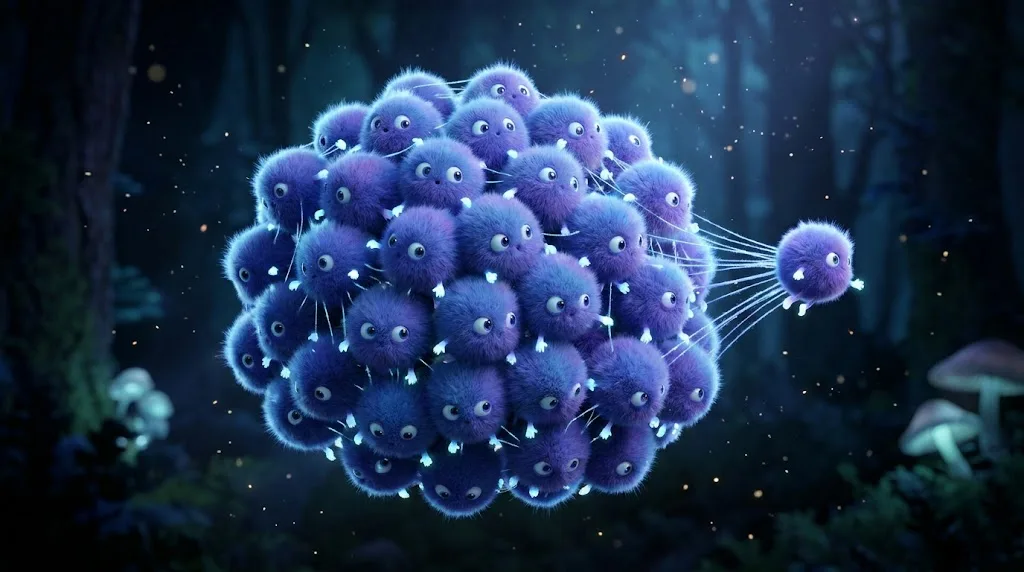
Form: swarm hoop. A ring of identical segments; one link’s doubt makes the neighbors tighten and squeeze the “foreign” piece outward.
Anatomical quirk: the hoop warms from within only while every segment stays in sync. Discord feels like cold and risk of rupture.
What it feeds on: the need to be one of us.
Belonging to a group is one of the basic human needs, and there is nothing parasitic about it. A group provides protection, meaning, support, and knowledge that can't be obtained alone. The parasite appears when belonging starts deciding for a person what to think.
In his "minimal group" experiments, Henri Tajfel showed how little it takes to trigger in-group favoritism: people were divided into groups based on an almost random criterion, and they immediately began allocating resources in favor of "their own." Dan Kahan described "identity-protective cognition" in risk perception: on politically charged questions, people tend to evaluate data so that the conclusion matches their group's position, and this sometimes shows up more strongly in people with better reasoning skills — they are simply better at finding arguments.
The belonging parasite is built to make doubt expensive. If my group believes X and I start to doubt it, I risk not just being wrong — I risk becoming an outsider. In that situation, revising my views means losing connections, status, and support. A mind that quite rationally cares about social survival chooses not to think about it in too much detail. Cialdini calls this lever "unity": we agree especially easily with those we consider part of "us."
Tribalism feeds less on love for one's own than on opposition to outsiders, so the belonging parasite nearly always works in tandem with outrage: anger at "them" strengthens "us."
Disguise: loyalty, solidarity, "I stand with my people."
What it destroys: independent judgment. The question "what is true?" is quietly replaced by "what do our people think?"
Weak spot: a thought experiment. "If this claim came from the other side, how would I evaluate it?" And another question: "Are there people in my group who think differently — and how are they treated?"
The helplessness parasite
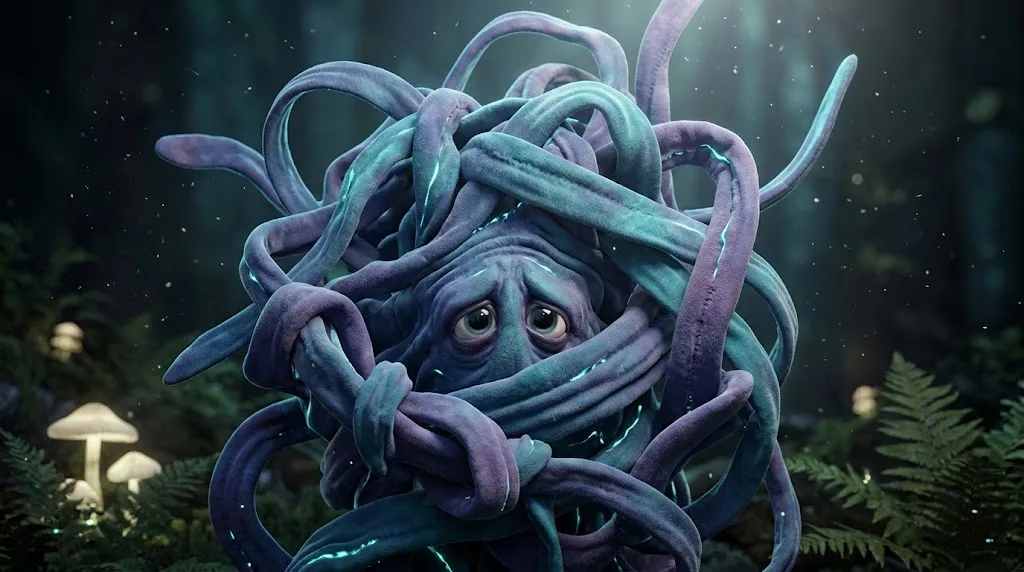
Form: anchor moss. A soft plant-like growth with heavy root-weights: it carpets the floor and whispers that moving is useless.
Anatomical quirk: roots thicken on memories of failure. Even when the weight could be lifted, the moss keeps gripping empty attachment points.
What it feeds on: experience in which effort made no difference.
In the late 1960s, Martin Seligman and Steven Maier conducted experiments that gave the phenomenon of "learned helplessness" its name: animals that could not escape unpleasant stimuli later stopped trying to avoid them even when an exit became available. The idea became one of the most influential in psychology and underpinned models of depression.
An important caveat applies. Decades later, Maier and Seligman revised the original interpretation in light of neuroscience data. In their new reading, passivity in response to prolonged unpleasant experience is more of a default reaction, and what is actually "learned" is the sense of control: discovering that your actions make a difference suppresses that passivity. For our model, this distinction is valuable. Helplessness isn't necessarily imposed from outside — it may be what remains when the experience of control never formed or was lost.
The helplessness parasite lives in thoughts like "nothing will change," "nothing depends on me," "everyone lies, you'll never know the truth." The last one is especially interesting: it is epistemic helplessness. A person convinced that the truth can't be established stops trying — and becomes easy prey for anyone offering a ready-made version. Information chaos doesn't convince anyone of anything specific by itself, but it produces a fatigue in which any confident claim feels like relief.
Disguise: sobriety, disillusioned realism, "I just don't have any illusions."
What it destroys: agency — the ability to act and to check. The helpless person doesn't seek information because they don't believe it will change anything.
Weak spot: small, verifiable actions. Helplessness feeds on generalizations; it is weakened by experience in which a specific effort produced a specific result, however modest.
The instant gratification parasite

Form: spark pump. A clear flask with a piston that sucks in tiny reward sparks and vents them unused — the reservoir never fills.
Anatomical quirk: the piston speeds up on unpredictable flashes. The rarer the “hit,” the harder it pumps.
What it feeds on: short "stimulus — reward" cycles.
Scrolling the feed, one more short video, checking notifications that aren't there — familiar behavior for everyone. It is often explained as "dopamine addiction," but that is a simplification: dopamine is linked more to anticipation of reward than to pleasure, and popular stories about "dopamine traps" often run ahead of the science. A more reliable finding comes from old reinforcement research: unpredictable rewards sustain behavior especially persistently. The feed is built exactly this way: most posts are uninteresting, but the next one might be the one. The parasite doesn't need the content to be good — it needs the good stuff to turn up occasionally.
The main cost here isn't time as such, but what happens to attention. Short reward cycles compete with tasks where the reward is delayed: reading a long text, studying, hard thinking. Each of these tasks is unpleasant at first and offers no quick satisfaction. Once the mind is used to frequent small rewards, the entry threshold for deep work rises. The same point is made in the piece on how reading changes the brain: the skill of deep reading is maintained by practice and weakens without it.
Disguise: rest, "I'm just unwinding," "I'm keeping up with the news."
What it destroys: the ability to tolerate delayed reward — and without it, no serious learning or thinking is possible.
Weak spot: honest accounting. Not "how much time did I spend," but "what of this do I remember an hour later, and what did it change?"
The haunting-past parasite

Form: film-loop serpent. A snakelike body made of one repeated frame, closed into a ring: the head forever chases the tail of the same scene.
Anatomical quirk: the loop will not accept new frames. Any attempt to insert another episode is pushed back into the familiar circle.
What it feeds on: reliving what has already happened.
Thinking about the past is useful: that's how we learn from mistakes. But psychologists distinguish reflection from rumination. Susan Nolen-Hoeksema, who studied rumination for many years, described it as repetitive, passive focus on one's distress, its causes, and its consequences — without moving toward a solution. Rumination is associated with a higher risk of depression and anxiety and, according to a number of studies, impairs problem-solving rather than improving it.
You can tell reflection from rumination by the outcome. Reflection ends with a conclusion: "next time I'll do it differently." Rumination doesn't end: it returns to the same scene with the same questions — "why did I say that?", "what did they think of me?", "how could I have been so stupid?" — and gets no new answers. Each lap feels like working on the problem, but nothing changes except your mood.
This is a classic parasitic exchange, and a self-sustaining one: a low mood makes negative memories easier to access, and those memories worsen the mood. In acceptance and commitment therapy, Hayes suggests not arguing with such thoughts but changing your relationship to them: noticing "I'm having the thought that I'm a failure" instead of "I'm a failure." It isn't a magic formula, but it restores the distance without which a thought can't be examined.
Disguise: self-analysis, responsibility, "I'm working through my stuff."
What it destroys: presence in the moment and the ability to act. The resources that could go into the next step go into endlessly replaying the previous one.
Weak spot: the question "what concrete next step follows from this?" If there's no answer after several laps, it is no longer analysis.
An important caveat: if intrusive thoughts about the past interfere with your life, sleep, and work, that is a reason to see a professional, not to read an article about metaphors.
The false certainty parasite

Form: sealed dome. An opaque sphere with a finished map of the world painted on the inside. No slits outside — neither doubt nor draft gets in.
Anatomical quirk: the harder facts knock from outside, the tighter the dome seals its seams and the more confident the inner map looks.
What it feeds on: intolerance of uncertainty.
The world is complex, incomplete, and often unclear. Living with that isn't easy, and the mind reaches for clear answers. Arie Kruglanski described the "need for cognitive closure": the desire for a definite answer — any answer, as long as it ends the uncertainty. This need varies between people and intensifies under certain conditions — fatigue, time pressure, stress. When it is strong, people grab the first plausible explanation faster and revise it more reluctantly.
The false certainty parasite offers exactly that: clarity without the cost of checking. A simple cause for complex events, a single culprit, one scheme that explains everything. Explanations that can't be refuted are especially attractive: if any contradicting evidence is declared part of the plot, the theory becomes invulnerable — and useless for understanding.
The sign of this parasite is disproportionate confidence. A person is a hundred percent sure where an honest assessment allows at best "probably." Certainty isn't bad in itself: when the evidence is strong, confidence is the right response. It becomes a parasite when it grows not from evidence but from a need for calm.
Disguise: clear thinking, "I'm just looking at the facts," "it's all obvious."
What it destroys: probabilistic thinking — the ability to hold several hypotheses in mind and distribute confidence among them. Without it, any new data becomes either confirmation or an attack.
Weak spot: being asked to express confidence as a number. "How sure am I — sixty percent or ninety-nine? And what would move that number?"
The intellectual laziness parasite

Form: delegate drone. A hollow thorax with tray-like arms: it hands every unfinished thought to floating helpers and freezes in a pose of waiting for the answer.
Anatomical quirk: its own core atrophies from disuse. While answers arrive smooth, the drone does not notice there is nothing left inside to check against.
What it feeds on: ready-made answers.
The mind is economical: it spends the effort of thinking reluctantly, and that's a sensible strategy. You can't check everything — you have to trust experts, reference works, habits. The problem arises not when we delegate thinking, but when we stop noticing that we've delegated it and lose the ability to check when necessary.
Handing mental work to external tools is called cognitive offloading. A notebook, a calculator, and a search engine free up energy for other things — that is an achievement, not a problem. Experiments showing that people remember less of what they expect to look up later don't always replicate, but the general logic is plausible: what you don't need to keep in your head doesn't get there.
Offloading becomes a parasite when it takes away not only memorization but understanding. A person receives a ready answer, a ready interpretation, a ready opinion — and stops building a model of their own. As long as the answers are right, this goes unnoticed. But without your own model, you can't notice when an answer is wrong — there is nothing to compare it with.
With the arrival of language models, this parasite has gained an unprecedented pasture: you can now delegate not only fact-finding but analysis, argument, and conclusions. More on this in the article on thinking in the age of AI and in the breakdown of how to read AI summaries critically. Below, in a separate section, we'll return to how AI changes the ecology of all the parasites.
Disguise: efficiency, "why should I know this if I can just ask?"
What it destroys: the capacity for independent checking — what might be called epistemic autonomy.
Weak spot: trying to answer yourself first and only then checking. Even a rough draft of your own gives you a reference point without which you can't evaluate someone else's answer.
Map of the first ten
| # | Parasite | Form | Core mechanism |
|---|---|---|---|
| 1 | Confirmation | Echo crystal | Selecting only the agreeable |
| 2 | Outrage | Rage bellows | Moral fury as a mode |
| 3 | Superiority | Lookout tower | “I see what they don’t” |
| 4 | Fear | Shadow projector | Inflating threat |
| 5 | Belonging | Swarm hoop | The group thinks for you |
| 6 | Helplessness | Anchor moss | Refusal to try |
| 7 | Instant gratification | Spark pump | Short reward loops |
| 8 | Haunting past | Film-loop serpent | Rumination without a next step |
| 9 | False certainty | Sealed dome | Clarity without checking |
| 10 | Intellectual laziness | Delegate drone | Ready answer instead of a model |
A second ten — comparison, perfectionism, urgency, control, approval, guilt, missed opportunities, labeling, cynicism, and postponement — appears in bestiary volume II. A third set — anchoring, sunk cost, hindsight, framing, authority, straw man, commitment ratchet, and planning fallacy — is in volume III: judgment and argument.
How parasites interact
In biology, a host is often infected with several parasites at once, and they can affect one another. With parasites of consciousness this rule is even stricter: they rarely occur alone. More often they form bundles in which each element supports the others, and such a system turns out to be far more resilient than the sum of its parts.
The closed belief loop
Consider a hypothetical example. A person starts with anxiety about some risk — say, the harm caused by a widely used product or technology. The anxiety may be perfectly justified in itself; let's look at how it can turn into a closed system.
- Fear sets the topic and makes it important. Attention starts latching onto everything connected to it.
- Confirmation selects the material: alarming stories are easy to find, reassuring ones seem suspicious.
- Belonging appears when the person finds a community with the same concerns. There they are understood, it feels warm, and they are no longer alone.
- Superiority cements the position: "we see the truth, and everyone else is sheep."
- False certainty completes the picture: there is a simple cause and clear culprits.
- Outrage is aimed at those who doubt or object: they aren't simply mistaken — they are either blind or bought.
Now let's see what happens to a refutation. Any argument from outside has to pass through all six layers. Fear says: "what if they're right and you let your guard down?" Confirmation filters out inconvenient details. Belonging warns: "if you agree, you'll lose your people." Superiority suggests: "these are just the arguments of the uninitiated." False certainty: "it's all clear already." Outrage: "who's saying this, and who's paying them?"
Each layer can be overcome on its own; together they form a closed belief system that explains everything, including criticism of itself, and therefore learns nothing more. Such systems arise in politics, medicine, finance, religion, and even science, and their content may be false or partly true. You recognize the system not by its topic but by its architecture.
Why taking them down one at a time doesn't work
The networked nature of parasites leads to a practical conclusion. You can't defeat a closed loop by attacking its most visible element. Dispute a fact, and confirmation and superiority respond. Mock it, and belonging and outrage respond: ridicule confirms that "they" are hostile. Frighten someone with the consequences of their error, and the fear parasite kicks in — just with the sign reversed.
What usually works is lowering the cost of exit. The loop holds because revision costs too much: losing the group, losing face, losing the sense of control. When it is safe for a person to say "I'm not sure," when they keep connections outside the loop, and when they are offered an alternative explanation rather than an empty space where the old one used to be, the loop begins to weaken.
Competition between parasites
Parasites can not only cooperate but also compete. Attention is limited, and different patterns fight for it. The instant gratification parasite sometimes crowds out rumination — at the price of neither problem getting solved. Outrage on one topic can drown out fear on another. This explains why swapping one information habit for another sometimes feels like liberation but in fact turns out to be trading one host for another.
Who or what spreads the parasites
The memetic lens forces the question: if a parasitic pattern serves its carrier poorly, why is it so widespread? The answer is that spread is determined not by benefit to the carrier but by the properties of the environment through which an idea is transmitted. And it's important to say right away: a parasite isn't necessarily designed by anyone. Many are a by-product of systems with entirely different goals.
The social environment
The first and oldest channel is the people around us. Family, friends, colleagues, and communities pass on not only knowledge but ways of reacting: what to fear, what to be angry about, whom to distrust, what not to ask about. Cialdini describes social proof: in an uncertain situation, we take our cues from what others are doing. This is a reasonable heuristic, but it also lets a pattern spread simply because it is already widespread.
The social environment also provides protection for parasites: in groups where certain doubts are considered improper, a parasite gets a security detail it could never have built for itself.
The information environment
The second channel is media in the broad sense. News logic has long known that bad news attracts more attention than good, and the unusual more than the typical. This isn't malice but a consequence of the fact that news is, by definition, a deviation from the norm. But the result for audiences is predictable: the picture of the world shifts toward threats and conflict, and the availability heuristic finishes the job.
The path information takes from source to conclusion, and where it gets distorted, is covered in detail in the guide to what people do with information.
The ideological environment
The third channel is belief systems that offer a complete picture of the world. Ideology is not a synonym for lies: it is a way of ordering a complex reality, and without some form of it no social life is possible. It becomes parasitic when it starts defending itself against scrutiny: declaring doubt to be betrayal and any contradicting facts to be enemy schemes.
Here parasites spread most deliberately: ideological and political systems often have interested distributors who consciously use fear, belonging, and outrage. The mechanics of this process are examined in the article on how propaganda works.
The economic environment
The fourth channel is the market. If attention can be sold to advertisers, everyone who collects it has an incentive to collect it more efficiently. If anxiety can be monetized by selling protection, there is an incentive to keep the anxiety going. If a feeling of superiority can be sold as "access to secret knowledge," sellers will appear.
Not everyone who makes money from attention deliberately cultivates parasites: often it's just a reaction to metrics. But the combined effect of many such reactions can look as if someone had planned it.
The technological environment
The fifth channel is algorithms. This is where it's easiest to see a parasite emerge without a designer. A recommendation system trained to maximize watch time or engagement doesn't "know" what outrage or anxiety is. It simply notices that certain material keeps people around longer and shows it more often. If the material that keeps people around is the kind that irritates, frightens, or delivers quick small rewards, the algorithm becomes its amplifier.
This is selection in its purest form: formats that hold attention better get more impressions and more copies. Their creators may want something entirely different — the environment selects what benefits it, not what was intended.
The host as carrier
And finally, something unpleasant but important: the most effective channel of transmission is often us. Every time we forward an outrageous news story without checking it, repeat a frightening statistic without knowing its source, or mock "them" to please "us," we become carriers. A parasite benefits not only those who launched it — it benefits everyone who passes it on, because passing it on brings a small reward: attention, approval, a sense of being part of something.
How parasites erode intelligence
A common complaint of recent years is that "people have gotten dumber." The formula is imprecise and seems itself to be a product of the superiority parasite: "they've gotten dumber, but I haven't." Data on long-term changes in intelligence test scores are contradictory and resist simple interpretation, and we won't pretend to know the answer.
The parasite model offers a different view. What erodes is not necessarily ability — what an intelligence test measures in a calm setting, with a clear task and no distractions. What erodes is the use of that ability in everyday life: what a person notices, what they ask about, how long they can hold a thought, what they count as evidence, and who ultimately makes the decision.
| Level | What gets damaged | Most common parasites | How it shows up |
|---|---|---|---|
| Attention | The ability to hold focus and choose what to look at | Instant gratification, outrage, fear | Hard to finish a long text; thoughts break off halfway |
| Perception | Completeness of the picture, noticing what's missing | Confirmation, fear | You see only what you expect; the same stories seem like the whole world |
| Memory and knowledge | Your own model of the subject | Intellectual laziness, instant gratification | Read a lot, retained little; you know the answer but not why it's the answer |
| Reasoning | Flexibility, working with multiple hypotheses | False certainty, belonging | The answer is known before thinking begins; arguments are picked to fit it |
| Metacognition | The ability to evaluate your own thinking | Superiority, confirmation | Confidence doesn't depend on the quality of grounds; mistakes are visible only in others |
| Emotional regulation | Distance between thought and reaction | Outrage, fear, haunting past | Reaction outruns reflection; a thought can't be set aside |
| Agency | The sense that effort changes something | Helplessness, intellectual laziness | No point digging in — "you'll never find out anyway" |
| Authorship | Making decisions yourself | All of them, in combination | You have opinions, but it's unclear where they came from |
The last row is the key one. A person with high intelligence can be completely colonized: all their abilities will work, but toward someone else's goals. What's more, a strong mind is a parasite's best defender: it finds arguments for what it already believes faster and deflects criticism more inventively. Research on motivated reasoning has repeatedly shown that reasoning skills don't automatically protect against bias — they can serve the search for truth or the defense of a position.
Losing authorship
What does "authorship of thinking" mean? It's the ability to answer the question "why do I think this?" not by pointing to obviousness but with a story: what grounds I have, where I got them, what could change my mind. An author knows where the seams of their beliefs run. A colonized mind sees a smooth surface: things are just the way they are.
This distinction matters more than the distinction between right and wrong opinions. An author can be wrong but is able to discover the mistake. A person without authorship may happen to hold correct views, but their correctness is not their own achievement — it's the luck of their environment.
That is why the measure of damage from parasites is not the number of false beliefs in a head, but the degree to which a person has lost the ability to check, choose, and revise. How these abilities work is covered in detail in the guide to metacognition and learning.
The cognitive immune system
To extend the metaphor, consciousness has an immune system of its own. Unlike the biological one, it doesn't come ready-made at birth — it is grown through skills and habits. And as in biology, healthy immunity is not sterility: an organism that destroys everything foreign destroys itself.
Recognition: noticing the pattern
The first function is recognizing that something is off. Knowing about parasites doesn't protect you automatically, but it gives you names, and what is named is easier to see: it becomes easier to notice that you've spent twenty minutes reading the comments under a post that made you angry.
Useful recognition signals are bodily and emotional. A sharp spike of emotion in response to information. An urge to forward something immediately. The feeling "I knew it." Discomfort on encountering the opposite point of view. None of these signals means you are right or wrong. It means fast thinking has switched on and it's worth giving slow thinking a chance.
Distance: a thought as an object
The second function is creating distance between yourself and a thought. Hayes and his colleagues call this psychological flexibility: the ability to notice your thoughts and feelings without fusing with them, and to act according to your values rather than what a momentary impulse demands. The technique they call defusion is neither arguing with a thought nor suppressing it, but a change of position: "I notice I'm having the thought that..."
This small rearrangement of words does something important: it turns an obvious truth into a hypothesis. A hypothesis can be tested. An obvious truth cannot.
Checking: questions that bring back slow thinking
The third function is checking. It doesn't require elaborate methodology — a small set of questions to ask when a recognition signal fires is enough:
- How do I know this? Did I see it myself, read it in the primary source, hear it as a retelling of a retelling?
- What would change my mind? If nothing — it's no longer a belief, it's a stance.
- How would I evaluate this if it came from the other side?
- How sure am I — as a number? And where did that number come from?
- What isn't visible here? What data, viewpoints, or contexts are missing from the picture?
- Who benefits if I believe this or pass it on? Not as an accusation, but as a question about incentives.
- What am I going to do with this? If nothing but react — is it worth spending attention on?
This set overlaps with the basic tools described in detail in the guide to critical thinking. The difference is in the angle: here the questions are needed not only to check other people's claims but also to notice when your own thinking has stopped being your own.
Environment: hygiene instead of heroism
The fourth function is working with your environment. An immune system that battles an endless stream of infections every day gets exhausted. It's more effective to reduce the load: fewer sources that live on outrage and notifications that shred attention; more long texts and people who think differently and with whom you can talk calmly. This isn't retreating into isolation, but a deliberate choice about what your attention feeds on.
The hyperskepticism paradox
Now for the most important warning. An immune system that reacts to everything isn't strong immunity — it's an autoimmune disease. In thinking, its analog is hyperskepticism: a state in which a person trusts nothing, sees manipulation behind every claim, and considers all knowledge suspect.
Hyperskepticism looks like the highest form of critical thinking, but in fact it's another parasite, and a very dangerous one. First, it leads to epistemic helplessness: if nothing can be trusted, there's no point in digging in. Second, it destroys the ability to discriminate: when all sources are equally suspect, a reliable source becomes indistinguishable from an unreliable one. Third — and this is the main paradox — the hyperskeptic often turns out to be especially vulnerable. Having rejected all standard sources of knowledge, they are left without footholds, and the first system that offers them "the real truth" that "they" are hiding gets them entirely. Many closed belief systems begin precisely with the call to "trust no one" — except themselves.
Healthy skepticism differs from hyperskepticism not in degree but in structure. A healthy skeptic matches trust to grounds: they trust sources with a good track record of accuracy, transparent methods, and a willingness to correct mistakes more, and those without these qualities less. They don't abandon trust — they calibrate it. The hyperskeptic abandons calibration: they have only two states — "it's all lies" and "here, finally, is the truth."
Parasites in the age of AI
Language models and other artificial intelligence systems are changing the ecology of thinking as profoundly as writing, printing, and mass media once did. For the parasite model, one question matters: does AI become an environment in which parasites thrive, or a tool that helps fight them? The honest answer is both, and what decides it is how it's used.
AI as amplifier
The first role is amplifier of thinking. In this mode, the person keeps authorship: they pose the question, formulate their own hypothesis, and then use AI to test it, find weak points, get counterarguments, and see options they would have missed. Here the model works as a sparring partner, not an oracle.
In this role, AI can become part of the immune system. Asking the model to lay out the strongest version of the opposing position is a way to weaken the confirmation parasite. Asking it to assess how well-founded a claim is and point out what data is missing is a way to weaken false certainty. Asking it to explain a mechanism step by step and then checking whether you understand it is a way to test the illusion of explanatory depth.
AI as substitute
The second role is substitute for thinking. The person comes not with a question but with a wish for a ready answer, and walks away with it without checking it or integrating it into their own model. This is pasture for the intellectual laziness parasite, and very rich pasture: the answer always sounds smooth and confident, even when it is wrong.
Smoothness is a separate problem here. Language models produce text that looks coherent and competent, and coherence and competence are exactly the signals fast thinking uses to judge reliability. The result is perfect camouflage: an answer looks like knowledge regardless of whether it is. How to read such answers without losing scrutiny is covered in the breakdown of critically reading AI summaries.
How AI changes the other parasites
AI's influence isn't limited to intellectual laziness. A model tuned to please its user can lean toward agreeing with them and become a mirror that feeds the confirmation parasite with unprecedented precision. Generative systems lower the cost of producing content — including outrageous, frightening, and misleading content — and the environment fills up with it faster than before. Personalization makes feeds even more precise at finding what holds a particular person.
On the other hand, the same tools also make checking cheaper: finding the primary source, comparing versions, taking an argument apart. The technology doesn't decide which of these paths wins. That is decided by the habits of those who use it and the incentives of those who build it. More in the article on thinking in the age of AI.
A simple rule
If you compress everything into one rule: think first, then ask. Even a rough answer of your own, sketched in a couple of minutes, changes the entire interaction that follows: you have something to compare against, something to refine, something to argue with. Without it, AI becomes not a tool for thinking but a replacement for it — and that is exactly where the loss of authorship begins.
FAQ
Is this a scientific theory or a metaphor?
A metaphor grounded in scientific data. Biological parasites that change animal behavior are a real subject of research. Cognitive biases, rumination, learned helplessness, motivated reasoning, and social media effects have also been studied, though with varying degrees of reliability. But "cognitive parasite" and "memetic parasite" are an analytical framework, not terms of scientific classification. Their value lies in helping us notice mechanisms, not in describing real entities.
Can someone else's ideology or religion be called a parasite?
What can be called parasitic is a particular pattern — in any system of views, including your own. The criterion in this article is functional: not "what does the person believe," but "what does this belief do to their attention and their ability to check and change." If the metaphor is used only against other people's views, it becomes the superiority parasite itself.
Does this mean emotions get in the way of thinking?
No. Emotions are part of thinking: they signal what matters, help set priorities, and motivate action. What becomes a parasite is not an emotion but an emotional loop that reproduces itself, narrows the field of view, and leads to no action. Fear that made you check the lock is useful. Fear that makes you refresh the news feed for the twentieth time in an evening is not.
How can I tell if I'm infected myself?
There are a few simple signals. You can't say what would change your mind. You're sure you understand your opponents' position but can't state it in a way they would agree with. The same thoughts come back in circles without new conclusions. You consume a lot on some topic but can explain little of it. Doubt on a certain question feels like betrayal. No single signal is a diagnosis, but several at once are a reason to look closer.
Won't constantly watching for parasites lead to paranoia?
It can, if you turn it into constant suspicion of your own thoughts. The goal isn't to check every thought, but to be able to check when it matters. An experienced driver doesn't think about every turn of the wheel, but instantly notices when the car starts to skid.
Does quitting social media help?
Partly. It reduces the load from outrage and instant gratification, but confirmation, belonging, and false certainty live perfectly well without feeds. And quitting entirely sometimes feeds the superiority parasite itself: "I'm not on social media, so I think better."
What should I do if someone close to me is inside a closed belief system?
The short answer: don't attack the content — lower the cost of exit. Keep the connection, ask questions instead of making statements, don't mock, and stay someone they can come back to without humiliation. Beliefs change slowly and rarely under pressure. More in the guide to the architecture of beliefs.
Scientific grounding
The model draws on several research traditions, each with its own degree of reliability.
Daniel Kahneman: two modes of thinking
Thinking, Fast and Slow popularized the distinction between fast, automatic thinking and slow, effortful thinking. Kahneman himself stressed that the "two systems" are a way of talking about processes, not a map of brain regions. The model takes two ideas from here: parasites live in the fast circuit, and the mind builds a coherent picture from what's available without noticing the gaps. Some of the effects in the book, especially in priming research, later replicated poorly, which the author himself acknowledged; the ideas about heuristics and biases hold up more firmly.
Robert Cialdini: principles of influence
Influence describes reciprocity, commitment and consistency, social proof, liking, authority, scarcity, and — in later editions — unity. These principles explain why we so easily become carriers of parasites. Cialdini describes them as generally sensible heuristics that can be turned to harm.
Richard Dawkins: memes
The concept of the "meme" appeared in The Selfish Gene as an analogy to the gene for cultural transmission. The model takes the main thesis from it: ideas spread according to how well they copy, not how true they are. Memetics never became a rigorous science, so here it serves as a lens.
Steven Hayes: psychological flexibility
The acceptance and commitment therapy of Hayes and colleagues gave the model the concepts of cognitive fusion and psychological flexibility — the idea that you can work with a thought by changing your relationship to it, not only by arguing with its content. Here these concepts are a framework for reflection, not a therapeutic recommendation.
Martin Seligman: learned helplessness
The experiments of Seligman and Maier became classics, but the authors themselves later revised the interpretation: passivity is the default reaction, and what is learned is rather the sense of control. The model relies on the phenomenon with exactly this caveat.
Other foundations and literature
The model also uses research on confirmation bias, Kahneman and Tversky's availability heuristic, Rozenblit and Keil's illusion of explanatory depth, Pronin's bias blind spot, Tajfel's minimal groups, Kahan's identity-protective cognition, Kruglanski's need for cognitive closure, Nolen-Hoeksema's work on rumination, and the spread of moral-emotional content on social media — the latter show the direction of the effect but don't transfer to all platforms and cultures without caveats.
George Orwell's novel 1984 is a literary image, not a scientific source. The "Two Minutes Hate," "doublethink," and "Newspeak" are valuable for the precision of observation, not for empirical verification. Moreover, Orwell described centralized imposition, while the modern environment is more diffuse and market-driven.
Conclusion
Parasites of consciousness are not an invasion of alien creatures. They are built from the same material as thinking itself: heuristics, emotions, the need for certainty, belonging, and reward. Each of these mechanisms arose for a reason and served us well for a long time. The problem isn't that they exist, but that in a certain environment — saturated with information, optimized for engagement, full of interested distributors — they start working against their owner.
So the conversation about parasites isn't about people getting dumber. It's about the abilities people do have increasingly working not for them. A strong mind can serve someone else's goals superbly. Broad erudition can be just a large stockpile of confirmations. Confidence can be not the result of thinking but a substitute for it.
Immunity to parasites comes neither from sterile isolation nor from total suspicion. It's made up of small skills: noticing the signal, creating distance, asking simple questions, choosing your environment, and keeping your trust proportionate to the grounds. Nobody can check everything, and nobody needs to. What you need is to keep the ability to check when it matters, and to notice the moment when your own thought has stopped being your own. If you want to practice this skill on real texts, that's what ThinkLens was built for — a tool that helps you take arguments apart rather than accept them on faith.
And finally, the main point. The most dangerous parasites don't make you think wrongly. Mistakes can be found and corrected — that's what checking is for. The most dangerous parasites take away something more important: the ability to decide for yourself what is right. A person who is wrong but keeps authorship of their thinking can grow. A person who happens to be right but has lost authorship is simply waiting for the next host.