
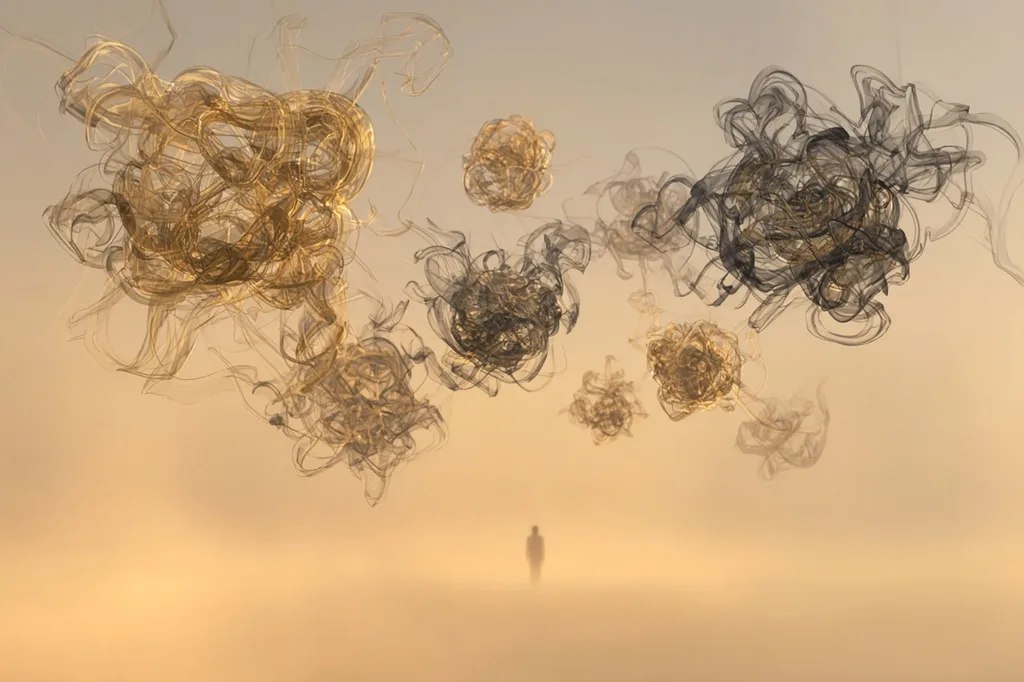
The first catalog — in Parasites of consciousness — gathered ten core mechanisms: confirmation, outrage, superiority, fear, belonging, helplessness, instant gratification, the haunting past, false certainty, and intellectual laziness. Those remain the foundation. This text is volume II: ten more creatures that do not repeat the patterns already described. They fill other gaps in attention, decision-making, and self-worth.
As before, “parasite” here is a metaphor, not a diagnosis. We are not talking about medical disorders or literal creatures in the brain. We are talking about stable thinking mechanisms that consume resources, disguise themselves as virtues, and undermine the ability to choose. The artistic forms — scales, hourglasses, a mirror-flower — are memory anchors: the silhouette should explain the mechanism even without a long caption.
Key takeaways
The second ten are about self-worth, action, and defense — not only about beliefs. The first ten more often capture a picture of the world. These ten more often break how you relate to yourself, to tasks, and to the future.
Each creature needs a unique silhouette and unique “physics.” Comparison sways, perfectionism polishes, urgency trembles, control spins threads, approval turns petals toward the viewer. Repeating another parasite’s anatomy breaks the catalog.
The metaphor must explain the mechanism. If a viewer cannot intuit what the creature is doing, the form is weak — beauty of the render notwithstanding.
They often chain with volume I. Comparison feeds superiority and belonging; urgency feeds false certainty; postponement partners with helplessness and instant gratification.
Each weak spot is a practice, not “just noticing.” Awareness without a changed criterion or action usually becomes fresh feed for the same parasite.
How to read this catalog
For each parasite below: what it feeds on, how it disguises itself, what it destroys, where its weak spot is — plus a short form description so an illustration can land later. Research next to the metaphor is not proof that “scales live in the brain”; it is ballast: the mechanism is familiar to science under other names.
If you have not read volume I, start with the main article: criteria for a parasite, three levels (biological / cognitive / memetic), and immune hygiene without hyperskepticism.
Catalog: creatures 11–20
The comparison parasite

Form: living scales. A long, flexible body with two movable pans and measuring protrusions along the back. One part always enlarges when the other shrinks: it has no stable size of its own.
What it feeds on: comparisons of achievement, appearance, income, status, and other people’s “success” — especially in feeds where other lives arrive as finished highlights without drafts.
Leon Festinger described social comparison as a way to evaluate yourself when objective measures are scarce. Comparison itself is useful: it teaches norms and calibrates goals. It becomes a parasite when someone else’s ruler becomes the only ruler. Then your own life stops being something you assess and turns into an endless match whose rules are written by an opponent you picked from a feed.
Upward comparison is especially toxic in environments that show only peaks of other people’s trajectories. You weigh your backstage against their façade — and the scales are rigged. The parasite does not care about fair weighing; it cares about the act of weighing.
Disguise: drive to grow, healthy competition, “I’m just seeing how others do it.”
What it destroys: the ability to evaluate your own life by internal criteria — progress versus yesterday’s you, fit with your values, a good enough “enough.”
Weak spot: the question “which scale am I using — and who chose it?” Stronger still: compare yourself not to a feed ideal but to yourself three months ago on one concrete parameter.
The perfectionism parasite

Form: the polisher. A perfectly smooth porcelain sphere with many tiny tool-hands; inside, a dark core. The more it polishes, the more clearly it sees new scratches: where one is removed, three appear.
What it feeds on: fear of error and dissatisfaction with any finished result.
Research distinguishes adaptive high standards from maladaptive perfectionism: in the latter, standards do not improve outcomes so much as block completion and amplify procrastination and self-criticism. The perfectionism parasite is not “love of quality”; it is a loop in which unfinished work feels safer than delivery — because undelivered work cannot yet be judged a failure.
It often partners with volume I’s superiority parasite (“if I do it, it must be flawless, or why bother”) and with postponement in this volume: polishing delays the moment of risk.
Disguise: high standards, quality, professionalism, “I just hate shoddy work.”
What it destroys: the ability to finish and accept “good enough” where endless polish costs more value than it adds.
Weak spot: a predeclared readiness criterion. “Done when A, B, and C are met — even if the surface is not yet a mirror.” Without an external criterion, the polisher never stops.
The urgency parasite

Form: living hourglass. Two chambers, a narrow neck, golden sand; instead of calm limbs, quick thin legs. Even when the sand runs out, the body keeps trembling, manufacturing a sense of running out of time.
What it feeds on: the feeling of deadlines, lateness, and the need to act immediately — regardless of the real cost of delay.
Eisenhower distinguished important from urgent; the urgency parasite erases that border. Whatever blinks, rings, and demands an answer “now” rises to the top — while what is important but quiet sinks. Chronic artificial hurry narrows thinking the way volume I’s fear does: under pressure people choose fast over right.
The environment feeds it gladly: notifications, “2 hours left,” red badges, expectations of instant reply. The parasite does not need a real deadline — only the sensation.
Disguise: productivity, responsiveness, responsibility, “I just hate dragging things out.”
What it destroys: the ability to set priorities and tell the important from the merely noisy.
Weak spot: ten breaths and the question “what happens if I do this in two hours — and what happens if I don’t do that quiet important thing today?” Urgency dislikes an inventory of consequences.
The control parasite
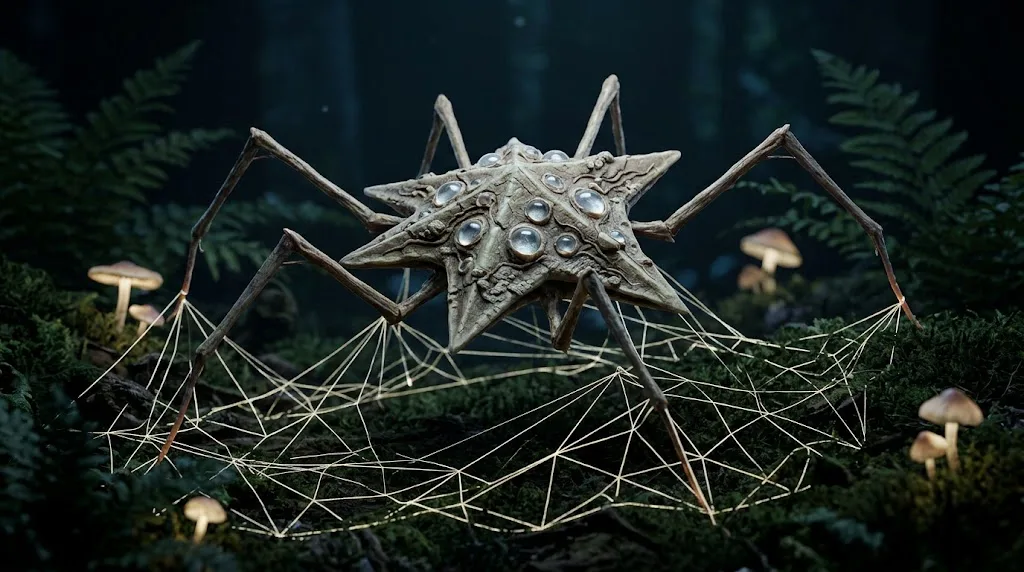
Form: living cartographer. A rounded organism like a sea star crossed with surveying gear; it spins the finest threads, trying to turn the world into a coordinate system.
What it feeds on: uncertainty, unpredictability, and the impossibility of managing circumstances.
Ellen Langer described the illusion of control: people overestimate their influence on chance events, especially when ritual, choice, or “their” button is present. The control parasite is a neighbor of volume I’s false certainty, but different: that one closes the world-picture with a ready answer; this one tries to hold the world with threads of plans, checks, and micromanagement.
While uncertainty is moderate, planning is strength. Control becomes a parasite when the cost of flexibility exceeds the cost of error: a person would rather wreck relationships, rest, and attention than leave any patch of life unschematized.
Disguise: foresight, organization, responsibility, “I just like order.”
What it destroys: flexibility, trust, and the ability to adapt when the map is outdated and the terrain has already changed.
Weak spot: deliberately leave one contour without a thread. “Today I do not control X — and I watch what actually happens.” A small dose of the uncontrollable often weakens the cartographer more than arguments about control.
The approval parasite

Form: mirror-flower. Movable mirrored petals around a nearly invisible core; each petal turns toward the observer and changes color with their reaction. Without attention the petals droop and turn nearly transparent.
What it feeds on: praise, recognition, attention, and external evaluation.
Contingent self-worth — “I’m okay only when the environment responds in certain ways” — is well described in motivation and self-esteem research. The approval parasite is not against being useful; it is against a desire existing without an audience. The inner compass is replaced by a panel of other people’s reactions: likes, nods, “well done,” silence.
It is often confused with volume I’s belonging. Belonging asks: “am I one of us?” Approval asks: “was I noticed and rated?” You can belong and still starve without applause — and the reverse.
Disguise: friendliness, modesty, wanting to be helpful, “I just care what people think.”
What it destroys: an inner fulcrum and the ability to define your own desires, boundaries, and direction.
Weak spot: do one thing you judge right before you learn others’ evaluation — and note how you feel before external voices arrive. The flower needs practice blooming without a hall.
The guilt parasite

Form: living burden-bearer. Thin legs, a huge transparent shell filled with heavy stones of different shapes and colors. The longer time passes, the heavier the shell — even when the stones no longer belong to the present.
What it feeds on: self-accusation, shame, and the habit of self-punishment.
Guilt in a working dose is a signal: “I violated my own norm; repair is possible.” Research distinguishes guilt (focus on the act) from shame (focus on a global “I am bad”); the parasite more often feeds on the second while wearing the mask of the first. It collects stones from the past and will not set them down even when apology, repair, or lesson is already done.
Unlike volume I’s haunting past, which replays a scene without a conclusion, the guilt-bearer has a conclusion — “I am to blame” — and uses it as perpetual ballast rather than a one-action task.
Disguise: responsibility, conscience, moral principles, “I just don’t let myself off the hook.”
What it destroys: the ability to repair mistakes and move energy into the present: force goes to carrying, not fixing.
Weak spot: an unloading ritual. “Which concrete stone have I not yet worked — with apology, repair, a changed rule — and which am I carrying with no work left?” The second kind can be set down on purpose.
The missed-opportunity parasite

Form: mirage-catcher. A light translucent creature with ribbon-like fins and empty glowing chambers inside. Its limbs stretch almost endlessly but almost never hold anything for long.
What it feeds on: fear of missing a better option — job, partner, idea, tab, course, the “real life” that supposedly starts after the next choice.
Barry Schwartz described maximizers versus satisficers: the former hunt for the best option and often end up less satisfied even with objectively good outcomes. The missed-opportunity parasite is a maximizer in FOMO packaging. It is not against curiosity; it is against closing a door.
While every door stays ajar, no room becomes yours. The parasite gathers sparks into empty chambers and calls that freedom.
Disguise: curiosity, openness to the new, rational search for a better option.
What it destroys: the ability to choose, focus, and finish what you start.
Weak spot: a timed closed-door rule. “For two weeks I will not entertain alternatives to X — only deepen what I chose.” The mirage-catcher weakens when the search horizon is temporarily narrowed by agreement with yourself.
The labeling parasite

Form: living stamper. A stamp-head, a body of cells holding ready-made symbols. It cannot take in an object whole: it must first mark it with one sign — after which interest in detail dies.
What it feeds on: the urge to classify people, events, and phenomena quickly in order to cut cognitive load.
Categories are necessary: without them the world is unmanageable. The parasite begins where the label replaces observation. A stereotype, a political stamp, a “feed diagnosis,” a professional tag on a person — after the strike, complexity disappears and attention can be saved.
It is related to false certainty and superiority, but the mechanism differs: not “I understand the whole world,” but “I already stuck a name on it — I can stop looking.”
Disguise: competence, experience, “I read people fast,” sober typology.
What it destroys: the ability to notice individual traits, exceptions, and internal contradictions — that is, to learn from reality.
Weak spot: a mandatory second mark. “What label did I just apply — and what fact contradicts it?” The stamper hates a second column.
The cynicism parasite
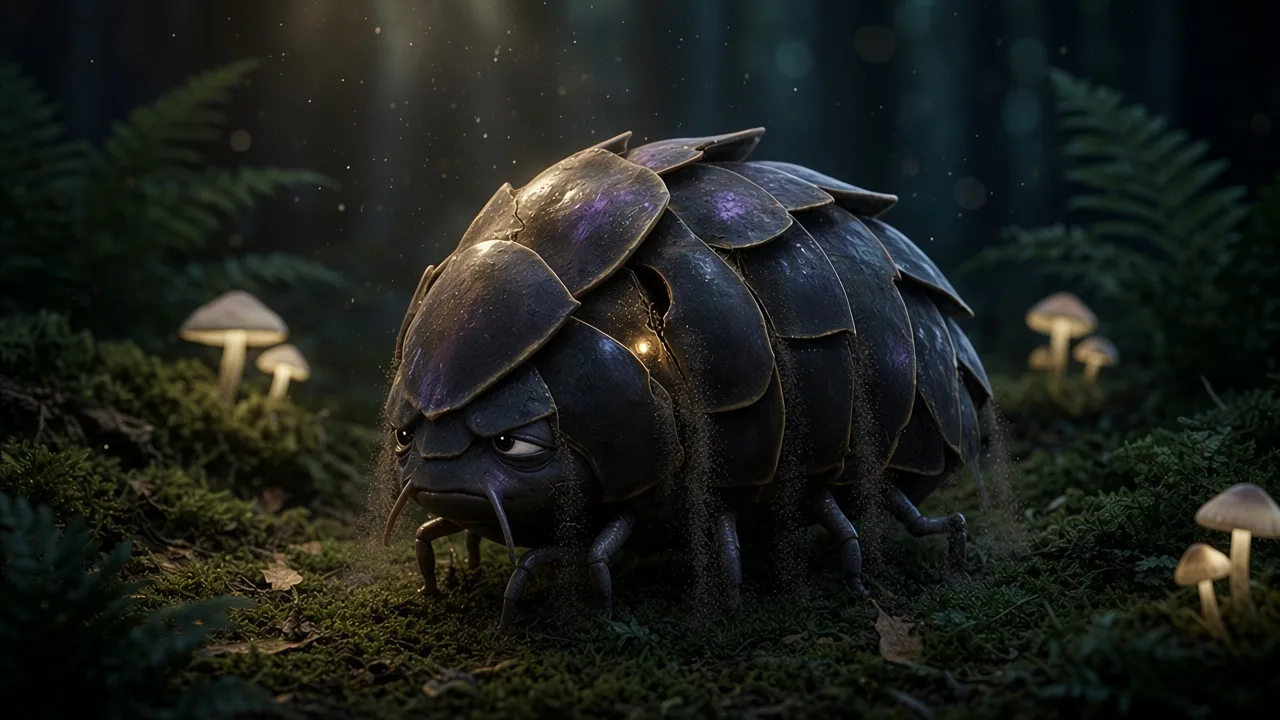
Form: closing shell. A seed-like creature under multilayered dark plates; inside, a small golden core almost never shown. At any flicker of hope or trust the shell tightens; a fine dark dust settles on what is nearby.
What it feeds on: disappointment, distrust, and negative expectations that “confirm” themselves through selective attention.
Skepticism is a tool. Cynicism is armor that confuses protection from pain with refusal of life. It often grows from real betrayal or naivete, which makes it persuasive: “I’m not stupid; I just don’t fall for it anymore.” The price is missed chances for trust, collaboration, and your own contribution: the shell does not distinguish a blow from a handshake.
Beside volume I’s helplessness, cynicism says: “trying is useless and hope is embarrassing.” Beside superiority: “only the naive believe.”
Disguise: realism, life experience, healthy skepticism, “I’m just being clear-eyed.”
What it destroys: the ability to trust in proportion, create anything new, and notice real signals — not only threatening ones.
Weak spot: a small, dosed trust risk with capped downside. “I will trust X in a zone where error is not catastrophe — and test the shell’s forecast against fact.” Cynicism dislikes narrow experiments; it prefers global conclusions.
The postponement parasite

Form: living cocoon-jellyfish. A soft translucent shell with elastic tendrils; it wraps tasks in a feeling of calm and safety while pushing them farther from the host.
What it feeds on: discomfort before starting something hard, dull, or risky.
Modern models of procrastination increasingly treat it not as “laziness” but as mood regulation: people delay to briefly reduce an unpleasant feeling — evaluation anxiety, boredom, uncertainty. The cocoon offers softness now; the bill arrives later as a heavier load and a stronger urge to hide again.
It allies with instant gratification (a short escape into the feed), perfectionism (“I’ll start when I’m perfectly ready”), and helplessness (“I won’t make it anyway”).
Disguise: preparation, gathering information, waiting for the right moment, “I just need to understand a bit more.”
What it destroys: the move from intention to action — agency at the starting line.
Weak spot: a two-minute entry rule. Not “do everything,” but “open the file / write the first sentence / set a ten-minute timer.” The cocoon weakens on the threshold, not in the middle of a grand plan.
Map of the second ten
| # | Parasite | Form | Core mechanism |
|---|---|---|---|
| 11 | Comparison | Living scales | Measuring the self only through others |
| 12 | Perfectionism | Polisher | Endless improvement instead of finishing |
| 13 | Urgency | Hourglass | Artificial hurry |
| 14 | Control | Cartographer | Trying to hold everything with threads |
| 15 | Approval | Mirror-flower | Self-worth from external reaction |
| 16 | Guilt | Burden-bearer | Self-punishment instead of repair |
| 17 | Missed opportunities | Mirage-catcher | Inability to choose |
| 18 | Labeling | Stamper | Replacing observation with classification |
| 19 | Cynicism | Closing shell | Protective distrust |
| 20 | Postponement | Cocoon-jellyfish | Flight from starting |
How volume II joins volume I
It is more useful to ask not “which one parasite do I have” but “which cluster is active now.” Typical bridges between volumes:
- Comparison → superiority / belonging. The scales demand either rising above or matching “our people.”
- Urgency → fear / false certainty. Hurry feeds anxiety and appetite for a quick ready answer.
- Control ↔ false certainty. Map and dogma often travel as a pair.
- Approval → instant gratification. The feed becomes a dispenser of external ratings.
- Guilt ↔ haunting past. Stones and memory loops reinforce each other.
- Missed opportunities → intellectual laziness. You can forever “research options,” outsourcing the choice to feeds and advice.
- Labeling → outrage. A stamp on “them” speeds moral mobilization.
- Cynicism → helplessness. “Hope is stupid” sits close to “nothing will change.”
- Postponement → perfectionism + gratification. The classic procrastination triangle.
Weakening a cluster still works better by lowering the cost of another behavior than by frontal assault on the loudest element: a small experiment, an external readiness criterion, a timed closed door, two minutes of entry. More on immune hygiene in volume I.
Rules for growing the bestiary
If the catalog grows again, three constraints keep it coherent:
- Unique silhouette. Do not repeat the anatomy of a parasite already described.
- Unique physics. Each moves differently: sways, polishes, trembles, threads, turns petals, carries stones, reaches for sparks, stamps, closes, wraps.
- Visual metaphor explains the mechanism. Even without text, a viewer should at least intuit what the creature is doing.
For short videos, the most “playable” creatures in this volume are comparison, perfectionism, missed opportunities, and postponement: their behavior is easy to make recognizable and slightly comic without sliding into horror.
FAQ for volume II
Are these twenty diagnoses?
No. They are twenty artistic personifications of stable mechanisms. Overlap with anxiety, depression, ADHD, or OCD can happen in a person’s life, but the article neither assigns nor lifts diagnoses. If a pattern breaks sleep, work, and relationships, that is a reason to see a professional — not a metaphor catalog.
How is volume II different from a list of cognitive biases?
A bias is an error or tilt in judgment. A parasite in this model is also a self-sustaining exchange: feed, disguise, cost to the host, weak spot. Form exists so the mechanism is hard to forget and easy to recognize in daily life.
Do I need to “defeat all twenty”?
No. Usually two to four are active. Notice the week’s dominant and train one weak spot — rather than staging a total purge that easily breeds hyperskepticism or a new polisher dressed as self-improvement.
What’s next
Portraits for creatures 11–20 are already in the text. The next layer of the series is volume III: judgment and argument (anchoring, sunk cost, hindsight, framing, authority, straw man, commitment ratchet, planning fallacy).
The core ten, parasite criteria, and cognitive immunity live in the first article. Nearby guides: architecture of beliefs, what people do with information, and thinking in the age of AI.