
📖 Table of Contents
Part 1: The World of Programming Around Us
Part 2: The Alphabet and Vocabulary of Programming
Part 3: Building Our First Programs
Part 4: Our Amazing Brain
Part 5: Creative Projects
Part 6: Programming in the Real World
Chapter 14 of 27
4: Our Amazing Brain
Chapter 14: "The Brain as a Supercomputer"
During the next meeting, Alice, Professor Bit, and Byte went to an unusual place — the city science museum, where there was an exhibition about the human brain.
— You know, Alice, — the Professor began when they stopped in front of a huge brain model, — we've talked a lot about computers, but haven't discussed the most amazing computer in the universe — the one in your head.
Alice looked at the Professor in surprise:
— You mean the brain? Is it like a computer?
— In a way, yes, — the Professor nodded. — Although the human brain and computer are structured differently, there's much in common between them. And perhaps most interesting — your brain in many ways surpasses even the most powerful computers in the world!
— Really? — Alice's eyes widened in surprise. — How is it better?
Logic, sitting on the Professor's shoulder, spread her wings:
— Let's start with the fact that your brain weighs about 1.5 kilograms, consumes less energy than a light bulb (only about 20 watts), but contains approximately 86 billion neurons that form more than 100 trillion connections!
Byte made a sound like a whistle:
— That's more than stars in our galaxy!
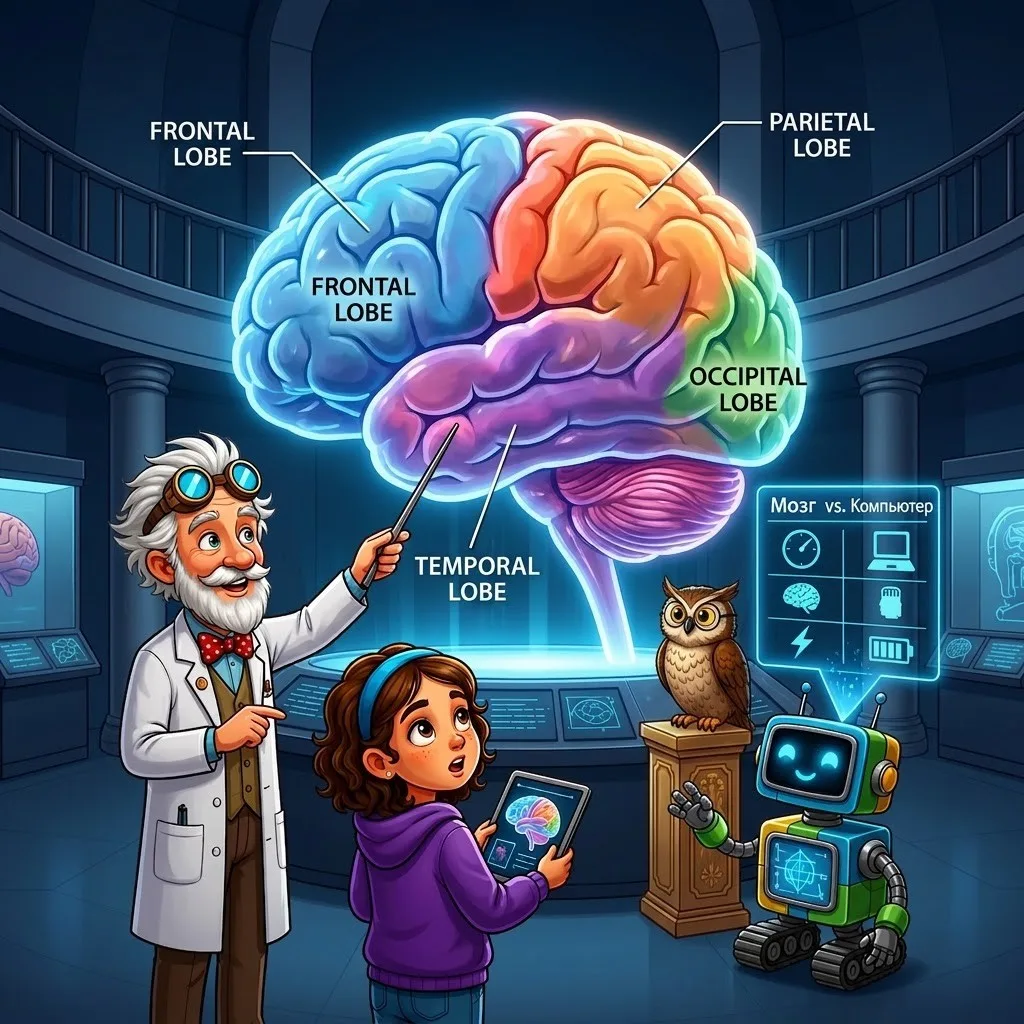
The Professor led Alice to an interactive screen showing a brain diagram with different colored zones.
— Look, Alice, the brain isn't just a homogeneous mass. It consists of different parts, each performing its functions, like different components of a computer.
The Professor pointed to different zones:
— Here's the frontal lobe — this is where planning, decision-making, and behavior control happen. It's like a computer's central processor. And here's the occipital lobe — it's responsible for processing visual information, like a graphics card in a computer. The temporal lobe processes sounds and participates in memory formation, and the parietal lobe is responsible for processing sensory information and spatial thinking.
— What's the most important part of the brain? — Alice asked.
— The most amazing thing in the brain is neurons, — the Professor replied. — These are special cells that transmit and process information.
Byte displayed an image of a neuron on his screen:
— Look, a neuron is like a tree with many branches. It has dendrites — extensions that receive signals from other neurons, a cell body where these signals are processed, and an axon — a long extension through which signals are transmitted further.
— How do neurons transmit information? — Alice wondered.
— Through electrical impulses and chemicals, — the Professor explained. — When a neuron receives enough signals from other neurons, it activates and sends its own electrical impulse along the axon. At the end of the axon, special chemicals are released — neurotransmitters, which cross a small gap called a synapse and affect the next neuron.
— This is like how transistors in a computer transmit electrical signals! — Alice exclaimed.
— Well observed! — the Professor praised. — Both transistors and neurons work on the "on-off" principle, though in reality neurons are much more complex and can have different degrees of activation.
Logic added:
— The key difference is that transistors in a computer work according to strictly defined rules and perform specific operations. But neurons can change their connections and ways of processing information. This is called neuroplasticity.
— Neuropla... what? — Alice asked again.
— Neuroplasticity, — the Professor smiled. — This is the brain's ability to change and adapt. When you learn something new, new connections form between neurons in your brain. The more you practice, the stronger these connections become. It's like making a path through a field — the more often you walk on it, the more noticeable it becomes.
— So I need to practice a lot to learn programming? — Alice asked.
— Exactly! — the Professor nodded. — And not just programming. Any skill develops this way: playing a musical instrument, sports, drawing, learning languages — all of this creates and strengthens neural connections in your brain.
Byte rolled up to an interactive exhibit where you could observe brain activity during various activities.
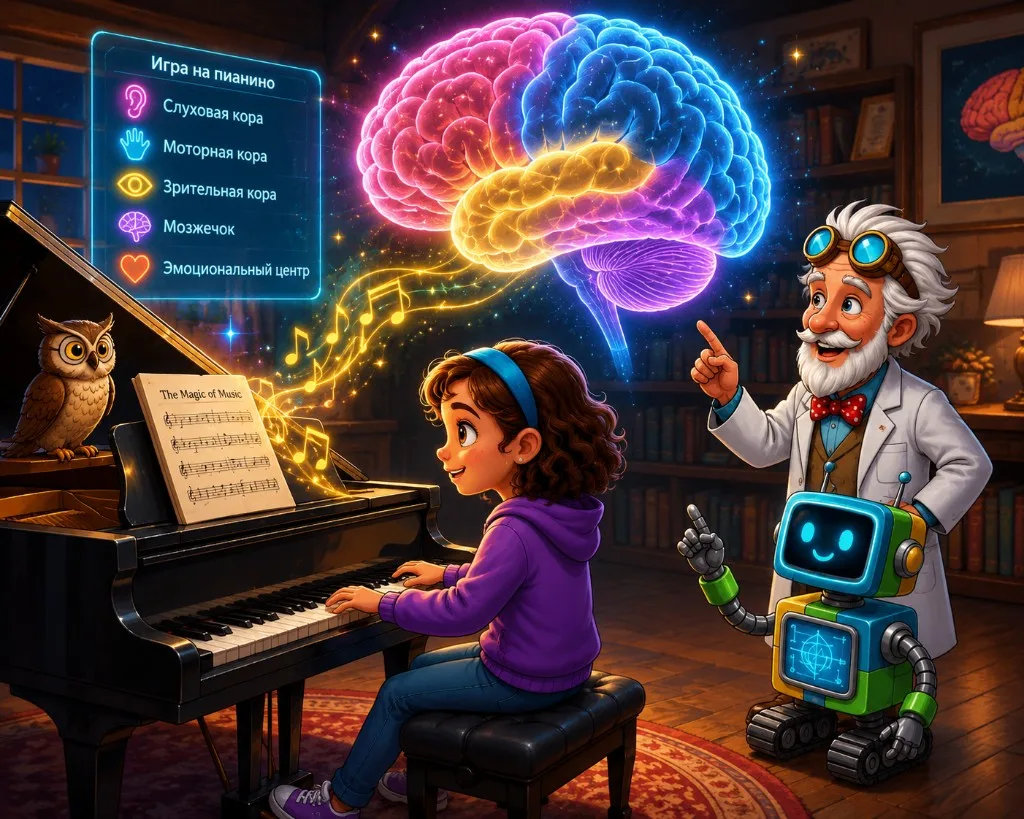
— Look, Alice, — he pointed to the screen. — When a person solves a math problem, certain areas of the brain activate. When listening to music — others. And when drawing — third ones. But most interesting happens when a person engages in several types of activities simultaneously — for example, playing the piano. Then many zones are involved at once: the motor cortex controls finger movements, the auditory cortex analyzes sounds, the frontal lobes track note sequences, and so on.
— Let's compare the brain and computer in more detail, — the Professor suggested.
Similarities:
1. Both receive information from outside (input)
2. Both process information
3. Both store information (memory)
4. Both output processing results (output)
5. Both use electrical signals
Differences:
1. Speed: Computers perform simple calculations much faster than the brain
2. Memory: Computers store information accurately, while the brain can distort memories
3. Energy efficiency: The brain consumes about 20 watts, while supercomputers consume megawatts
4. Learning: The brain learns independently, while a computer needs to be programmed
5. Creativity: The brain creates and invents new things, computers strictly follow algorithms
6. Parallelism: The brain processes many signals simultaneously, while most computers do it sequentially
He paused for a moment and quietly read:
В черепной коробке — целый свет,
Миллиарды тонких проводов.
Нет системы вычислительней, чем эта:
Твой разум — среди лучших из миров.
Каждый нейрон — крошечный мосток,
Связь рождается от мысли в мысль.
Чем ты чаще проходишь этот путь,
Тем тропинка в голове видней.
Он не дремлет даже в тишине:
Слышит, видит, помнит и творит.
Суперкомпьютер живёт в тебе —
И ничто его не повторит.
— So the brain is both better and worse than a computer? — Alice clarified.
— It's more accurate to say they're different and complement each other, — the Professor replied. — For example, a computer can instantly multiply two large numbers, while it's difficult for the brain. But the brain easily recognizes a friend's face in a crowd, while for a computer this is a complex task.
— And could a computer ever become smarter than a human? — Alice asked.
— This is a complex question, — the Professor replied thoughtfully. — Computers are becoming more powerful, and scientists are trying to create programs that imitate brain function. But human consciousness, emotions, intuition — all of this still remains a mystery even to science.
Logic added:
— Many scientists believe the best path is not competition between the brain and computer, but their cooperation. Humans and machines together are capable of more than separately.
— Like how Byte helps us learn programming! — Alice guessed.
— Exactly! — the Professor smiled. — And in the next chapter we'll talk in more detail about how thoughts and memory work, and how our brain stores and processes information.