
📖 Table of Contents
Part 1: The World of Programming Around Us
Part 2: The Alphabet and Vocabulary of Programming
Part 3: Building Our First Programs
Part 4: Our Amazing Brain
Part 5: Creative Projects
Part 6: Programming in the Real World
Chapter 15 of 27
4: Our Amazing Brain
Chapter 15: "How We Think and Remember"
The next day, Alice met Professor Bit in the park. He was sitting on a bench, deep in thought, and didn't even notice when she approached.
— Professor! What are you thinking about so deeply? — Alice called out to him.
The Professor slightly started and smiled:
— Oh, hello, Alice! I was just thinking about thinking.
— About thinking? — Alice was surprised.
— Exactly! — the Professor nodded. — I was thinking about what thoughts are and how memory works. That's exactly the topic of today's lesson.
Byte rolled up to them with a small box in his hands:
— I have a surprise for you, Alice! — He handed her a box containing a plastic helmet with colorful sensors.
— What is this? — Alice asked, examining the unusual gift.
— This is a neurointerface, — the Professor explained. — A very simplified version, of course. It can't read your thoughts, but can determine which brain zones are active when you think or remember.
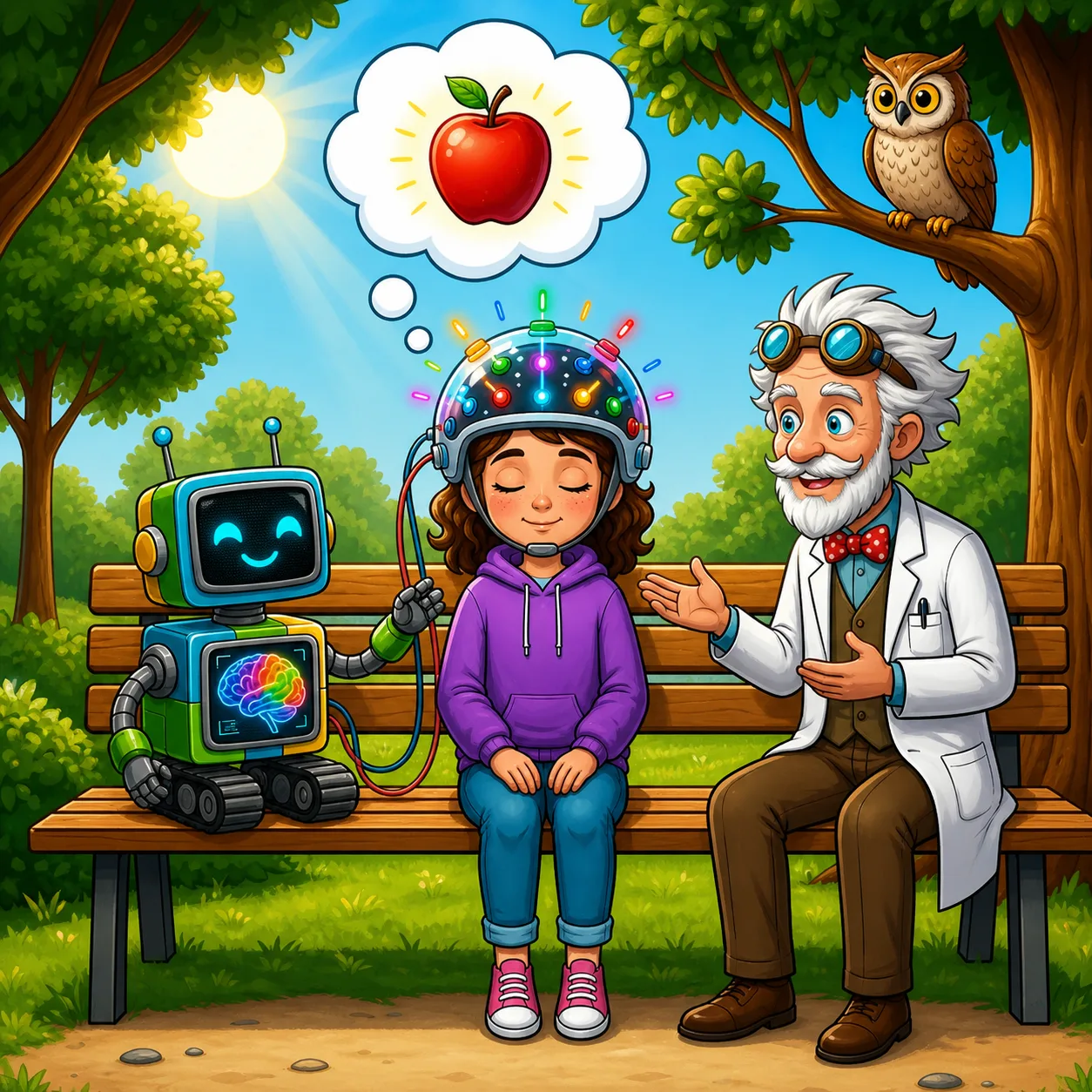
Alice carefully put on the helmet, and Byte turned on an app on his screen showing a colorful brain diagram.
— Now we can see how your brain works! — Byte exclaimed. — Try thinking about something.
Alice closed her eyes and imagined an apple.
— Look, — the Professor pointed to Byte's screen, — activity appeared in your visual cortex. Even when you just imagine an apple, the same neurons activate as when actually seeing it, though not as strongly.
Там, где скрыты тайны и загадки,
В лабиринтах разума людей,
Загораясь в правильном порядке,
Мчатся токи мыслей и идей.
Стоит лишь закрыть на миг ресницы,
Что-то вспомнить, выдумать пейзаж, —
Как в мозгу проносятся зарницы,
Собирая красочный мираж.
Мысль летит быстрее птичьей стаи,
Строит замки, звёзды и мосты.
Мы внутри себя изобретаем
Мир невероятной красоты!
— What are thoughts, from a scientific point of view? — Alice asked, taking off the helmet.
— Great question! — The Professor sat down on the bench. — Thoughts are the result of neuron activity in your brain. When you think, millions of neurons activate in certain patterns and sequences.
— Like Christmas lights that light up in a certain order, forming a pattern? — Alice suggested.
— Very apt comparison! — the Professor was pleased. — But a garland usually repeats the same sequence again and again. Neural patterns constantly change, like a kaleidoscope, creating infinite variety of thoughts.
Logic, sitting on a branch of the nearest tree, added:
— Interestingly, the brain never fully rests. Even in sleep, complex processes occur: sorting impressions, forming memories, solving problems.
— How does memory work? — Alice wondered. — Where are our memories stored?
— Unlike a computer, the brain doesn't have a separate "hard drive" for storing memories, — the Professor explained. — Memories are distributed throughout the brain in the form of connection patterns between neurons.
The Professor pulled a notebook from his pocket and drew a diagram:
Receiving information → Short-term memory → Long-term memory— When you first encounter information, it first goes into short-term memory. It's like a computer desktop — here's stored what you're working with right now, but there's not much space.
— And how much information fits there? — Alice asked.
— On average, a person can hold 5 to 9 elements in short-term memory, — the Professor replied. — For example, if I name 10 random numbers, you probably won't be able to repeat them all at once.
— What happens next? — Alice wondered.
— If the information is important or you repeat it several times, it transfers to long-term memory, — the Professor continued. — It's like moving files from the desktop to organized folders on the hard drive. In long-term memory, information can be stored for years or even a lifetime.
Byte showed an animation of the memorization process on his screen:
— When you remember something, new connections form between neurons in your brain or existing ones strengthen. This is called synaptic plasticity. The more often you recall or use this information, the stronger these connections become.
— That's why it's important to repeat what you want to remember, — the Professor added. — But not just mechanically, but with intervals. This is called spaced repetition.
— Why with intervals? — Alice asked. — Isn't it better to repeat again and again without breaks?
— Actually, no, — the Professor smiled. — Research has shown that the brain remembers better if information is repeated at certain intervals. It's like with plants — they need to be watered regularly, but not constantly, otherwise the roots will rot.
Logic flew closer:
— There's even a special formula for effective repetition. For example, after learning something new, repeat it after 1 day, then after 3 days, then after a week, after a month...
— With each repetition, the interval can be increased, — the Professor continued. — This forms strong neural connections, and information is retained for a long time.
— What if I forgot something? — Alice asked.
— Forgetting is a normal process, — the Professor reassured her. — The brain constantly filters out unnecessary information to avoid overload. It's like cleaning a computer — unused files are deleted to free space for new ones.
— But sometimes we forget important things too, — Alice noticed.
— Yes, that happens, — the Professor agreed. — Memories can "fade" over time if we don't access them. Or they can be temporarily unavailable — you know you remember something, but can't recall it right now.
— Like the name of a person you haven't seen in a long time! — Alice exclaimed. — You know you know it, but the name has slipped your mind.
— Exactly! — the Professor nodded. — And it's also interesting that our memories aren't exact copies of events. Every time we remember something, the brain actually "recreates" that memory, sometimes adding new details or changing existing ones.
— So our memories can be inaccurate? — Alice was surprised.
— Yes, and that's normal, — the Professor replied. — The brain doesn't record events like a video camera. It saves key details and general impression, and builds the rest when needed for recall. That's why witnesses to the same event can remember it differently.
Byte showed a diagram of different memory types on the screen:
Long-term memory
├── Declarative (explicit) memory
│   ├── Semantic memory (facts, knowledge)
│   └── Episodic memory (personal events)
└── Procedural (implicit) memory
    ├── Motor skills (riding a bicycle)
    └── Habits and conditioned reflexes
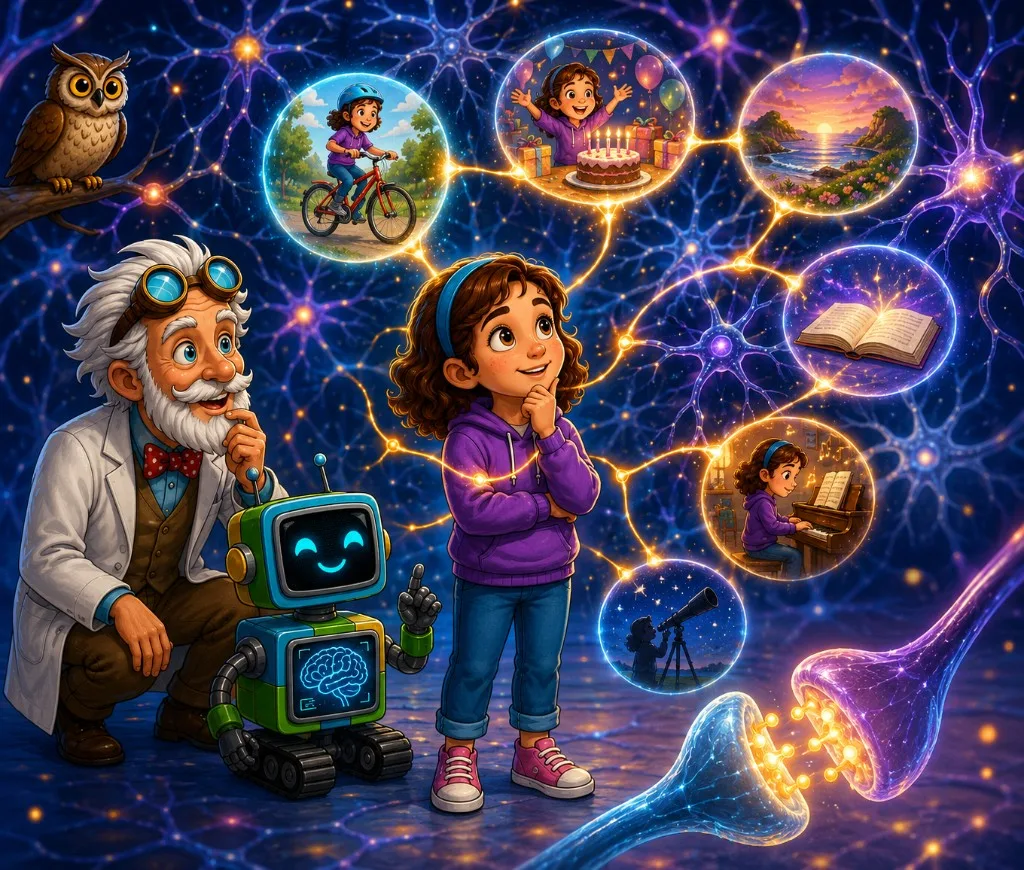
— Semantic memory is knowledge about the world: that Earth is round, that 2+2=4, that Paris is the capital of France, — the Professor explained. — Episodic memory is personal memories: your last birthday, first day at school, trip to the sea.
— What about procedural memory? — Alice asked.
— That's memory of how to do something, — the Professor replied. — Interestingly, you can forget the theory of bicycle riding, but your body will still remember how to keep balance. This memory is formed through practice and repetition.
— Procedural memory is very stable, — Logic added. — That's why they say: "It's like riding a bicycle — once you learn, you never forget."
— Why don't I remember learning to walk or talk? — Alice wondered.
— This is related to so-called childhood amnesia, — the Professor explained. — Most people don't remember events before age 3-4. There are several theories why this happens, but one is related to the fact that at this age the hippocampus — the part of the brain responsible for memory formation — isn't fully developed yet.
— But much of what you learned in early childhood, especially languages, is remembered more easily and firmly, — Logic noticed. — This is because the child's brain has high plasticity — the ability to form new neural connections.
— Exactly! — the Professor continued. — In childhood, the brain is in a state of active development and tuned for learning. That's why it's so easy for children to learn new languages — their brain is literally "tuned" to absorb this information.
— Does this ability disappear with age? — Alice asked worriedly.
— It doesn't disappear completely, but changes, — the Professor reassured her. — Adults need more effort and practice to learn what a child picks up quickly. But adults understand connections between concepts better and can use existing knowledge.
— And most importantly, — Logic added, — at any age the brain retains the ability to learn and change. This is called neuroplasticity, and in the next chapter we'll talk more about how to develop your brain and keep it in good shape.