
📖 Table of Contents
Part 1: The World of Programming Around Us
Part 2: The Alphabet and Vocabulary of Programming
Part 3: Building Our First Programs
Part 4: Our Amazing Brain
Part 5: Creative Projects
Part 6: Programming in the Real World
Chapter 22 of 27
6: Programming in the Real World
Chapter 22: "Who You Can Become if You Love Programming"
Один возведёт виртуальный портал,
Другой рассчитает орбиту планет,
А третий — создаст для людей терминал,
Который подарит надежду и свет.
Здесь код — это компас, радар и броня,
И мост для общенья, и верный маяк.
И кем ты окажешься с нового дня,
Решает твой первый уверенный шаг.
One weekend, Professor Bit organized an unusual meeting. He invited Alice to a coworking center where people of different ages and professions had gathered.
— Today is a special day, — the Professor announced when they entered a spacious room with large windows. — You'll meet people who use programming in different professions. I invited my former students, friends, and colleagues to tell you about their work.
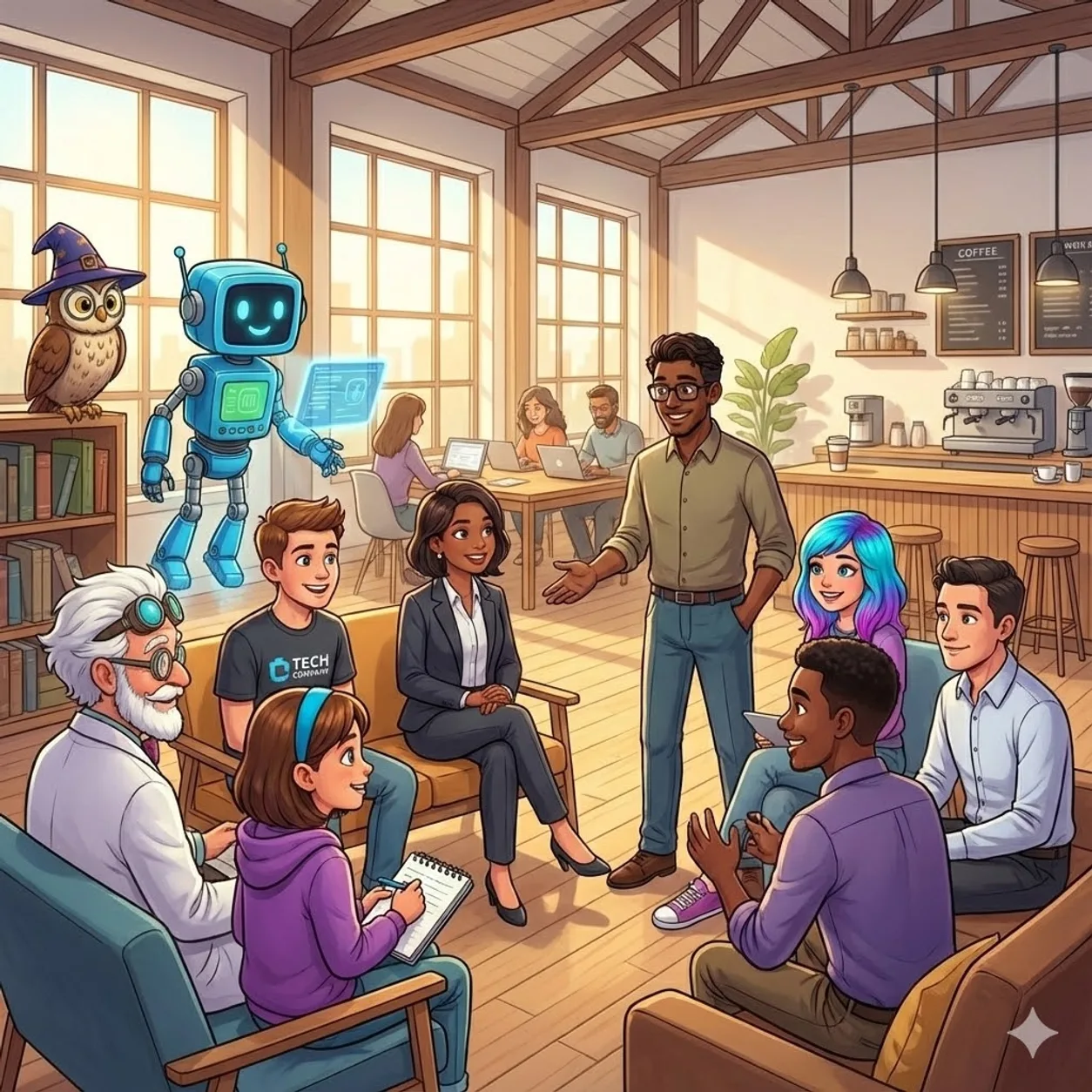
The first to speak was a young man in jeans and a T-shirt with a well-known company logo.
— Hi, I'm Mark, a mobile app developer, — he introduced himself. — I create apps that people use every day on their smartphones. The most interesting thing in my work is seeing how your code turns into a useful tool that helps people solve their tasks.
— What skills are needed to become an app developer? — Alice asked.
— Of course, you need to know programming languages, — Mark replied. — For iOS it's usually Swift, for Android — Kotlin or Java. But it's equally important to understand interface design principles, work in teams, and most importantly, put yourself in the user's place: what will be convenient for them, what won't.
Next, a middle-aged woman in an elegant business suit spoke:
— My name is Irina, I'm a data analyst at a large retail company, — she said. — I use programming to analyze large volumes of information about sales, customers, and products. Based on this analysis, the company makes important decisions: what products to buy, how to plan promotions, where to open new stores.
— I work mainly with R and Python languages, — she continued. — Knowledge of statistics, the ability to visualize data, and communication skills are also important — you need to not only find insights in data but also be able to clearly explain them to non-technical specialists.
Alice listened attentively and took notes in her notebook.
Next was a tall man with glasses.
— I'm Alexander, a game developer, — he introduced himself. — We create worlds where people can get new experiences, solve interesting problems, and just have fun. The game industry is a combination of technology, art, and psychology.
— To create games, you need to know programming languages like C++ or C#, — he explained. — It's also important to understand the basics of physics, animation, 3D modeling, sound design. A game developer is like a film director — they must unite different elements into a single whole.
Then a girl with bright hair spoke:
— My name is Sonya, I'm a web developer, — she said. — I create websites and web applications. From simple blogs to complex portals with millions of users. The internet is a huge platform that allows sharing ideas, information, and services worldwide.
— In web development, HTML, CSS, and JavaScript are used for the frontend — the part the user sees, — she explained. — For the backend — the server part — Python, PHP, Ruby, Node.js, and other technologies can be used. Web development is good because the entry threshold is quite low, but there's always room to grow and develop.
— And I'm Kirill, a cybersecurity specialist, — the next guest introduced himself, a man in a formal shirt. — My task is to protect information systems from hacks, viruses, and other threats. It's like a game of cat and mouse, only the stakes are very high — confidential data, finances, company reputations.
— In cybersecurity, deep understanding of how computer systems, networks, and operating systems work is important, — he explained. — You need to know programming languages to find vulnerabilities in code and create protective mechanisms. Critical thinking and creativity are also important — hackers constantly come up with new attack methods, and we must be one step ahead.
After each specialist's presentation, Alice and other guests could ask questions. Gradually, the meeting turned into a relaxed conversation where various aspects of working in IT were discussed.
— How did you realize you wanted to do this? — Alice asked Sonya, the web developer.
— I had a travel blog and wanted to make it special, — Sonya replied. — I started learning HTML and CSS, then got hooked and realized I like creating interfaces. What started as a hobby grew into a profession.
— What's the hardest thing in your work? — Alice asked Kirill.
— Probably that technologies and attack methods constantly change, — he thought. — You need to constantly learn, keep up with news, test new tools. But that's also the most interesting part — it's never boring.
After the main presentations, the Professor invited several more people who talked about their work.
A programming researcher from a scientific institute told how he creates models for weather and climate change prediction. His programs process data from satellites, weather stations, and sensors worldwide.
A DevOps engineer explained how he ensures uninterrupted operation of services used by millions of people, automates deployment and testing processes for software.
A machine learning specialist told how she creates algorithms that learn to recognize images, translate texts, and recommend content.
A technical writer shared experience creating documentation for software — clear instructions and guides for users and developers.
An IT project manager told how she coordinates work of teams of developers, designers, testers to create complex software products on time and within budget.
— Are there professions where programming is useful but isn't the main activity? — Alice asked.
— Great question! — the Professor praised. — Actually, there are more and more such professions. Does anyone have examples?
— I'm a biologist, — a woman from the far corner of the room responded. — I use programming to analyze genetic data. We sequence genomes and use algorithms to find genes associated with various diseases.
— And I'm a financial analyst, — a man in a suit added. — I create models for market prediction and risk assessment. Without programming, this would be impossible.
— I'm an architect, — a young woman said. — I use programming to create parametric building models, optimize structures, and simulate environmental conditions.
People one after another named their professions: a journalist using scripts to collect and analyze data; a teacher creating interactive learning materials; a musician experimenting with algorithmic compositions; a marketer automating analysis of advertising campaign effectiveness.
— As you can see, — the Professor summarized, — programming is becoming a universal skill useful in almost any field.
— What about the future? — Alice asked. — What new professions might appear?
— New specialties are already forming, — the machine learning specialist replied. — For example, AI ethics engineers who ensure artificial intelligence systems make fair and unbiased decisions. Or augmented reality specialists creating interactive overlays on the real world.
— In the future, smart city designers, digital health specialists, space programmers for working with systems on other planets might appear, — Mark added. — And many professions we can't even imagine now.
— But how do you choose your path among such diversity? — Alice asked, looking somewhat confused at her notes.
— Start with what truly interests you, — Irina advised. — What do you like to do, what problems would you like to solve?
— Try different things, — Alexander added. — There are many free online courses available where you can get acquainted with different areas of programming.
— And remember that in IT there's always an opportunity to change direction, — Sonya noted. — I started as a frontend developer, then worked on mobile apps for several years, and now I've returned to web development, but at a more advanced level.
— The main thing is not to stop developing, — Kirill emphasized. — Technologies constantly change, so it's important to be able to and love learning.
By the end of the meeting, Alice felt inspired by the opened prospects.
— Thank you for organizing this meeting, Professor, — she said when they left the coworking space. — Now I understand how diverse the path in programming can be.
— I'm glad you liked it, — the Professor smiled. — Remember the main thing: programming is a tool for bringing ideas to life. Choose what truly interests you and use this tool to create something meaningful.
Task
1. What do specialists in this profession do?
2. What skills and knowledge are necessary?
3. Why is this interesting to you?
4. What project would you like to implement working in this field?
Then choose one of these professions and draw yourself in this role in 10 years. What are you creating? What problems are you solving? Who are you working with?