
📖 Table of Contents
Part 1: The World of Programming Around Us
Part 2: The Alphabet and Vocabulary of Programming
Part 3: Building Our First Programs
Part 4: Our Amazing Brain
Part 5: Creative Projects
Part 6: Programming in the Real World
Chapter 25 of 27
7: From Electricity to AI
Chapter 25: "From Mechanical Counters to Smart Machines"
After visiting the science and technology museum, Alice became interested in the history of computing device development. Professor Bit noticed her curiosity and proposed a special lesson dedicated to the evolution of computers.
In his laboratory, he prepared a small exhibition, gathering models and images of the most important computing devices in human history.
— Welcome to a journey through time! — the Professor announced when Alice crossed the threshold. — Today we'll trace the path from the simplest counting devices to modern computers and artificial intelligence.
He paused for a moment and quietly read:
От древних счёт на тонкой нити,
От шестерёнок и валов
Сплеталась летопись открытий,
Понятных всем без лишних слов.
На смену медному узору
Пришёл электрики поток.
И то, что занимало гору,
Вместилось в крошечный брелок.
От перфокарт — до нейросетей,
От медных дуг — к уму машин.
Мы на пороге тех столетий,
Где нет пределов и вершин!
The Professor led Alice to the first exhibit — a model of an abacus, an ancient counting device with beads on wires.
— Here it is, humanity's first computer, — the Professor smiled. — The abacus, or counting frame, appeared more than 5000 years ago in ancient Babylon and China. This simple device allowed performing quite complex calculations much faster than on fingers.
— But this is just a mechanical device, — Alice noticed. — Can it really be called a computer?
— In a broad sense, a computer is a device for computation, — the Professor replied. — Although, of course, the modern meaning of this word implies much more complex machines. But it's interesting to note that the basic principles of storing and manipulating numbers were laid down even then.
Byte rolled up to the next exhibit — a model of a slide rule.
— And here's another important invention, — he said. — The slide rule, invented in the 17th century, allowed performing multiplication, division, and other complex operations using mechanical addition of segments.
— The first true mechanical calculator can be considered Pascal's calculator, — the Professor continued, showing the next exhibit. — Blaise Pascal, a French mathematician and philosopher, created it in 1642 when he was only 19 years old. The device could add and subtract numbers using a system of gears.
— And who created the first programmable computer? — Alice asked.
— That's an interesting story, — Logic replied, pointing to a portrait of a man in old-fashioned clothing. — In 1837, English mathematician Charles Babbage developed a design for the "Analytical Engine" — the first programmable mechanical computer. Although he couldn't build it fully due to technological limitations of that time, his ideas were decades ahead of their era.
— And who wrote programs for this machine? — Alice wondered.
— Lady Ada Lovelace, the daughter of poet Byron, — Byte proudly replied, pointing to a portrait of an elegant woman. — She created the first algorithms for the Analytical Engine and is considered the first programmer in history. The programming language Ada is named in her honor.
— But there was still much time before the creation of electronic computers, — the Professor continued. — One important step was Herman Hollerith's tabulating machine, created for processing US census data in 1890. It used punch cards for data input — a principle that was then used in computers for decades.
They moved to the next section, where models of the first electronic computers were presented.
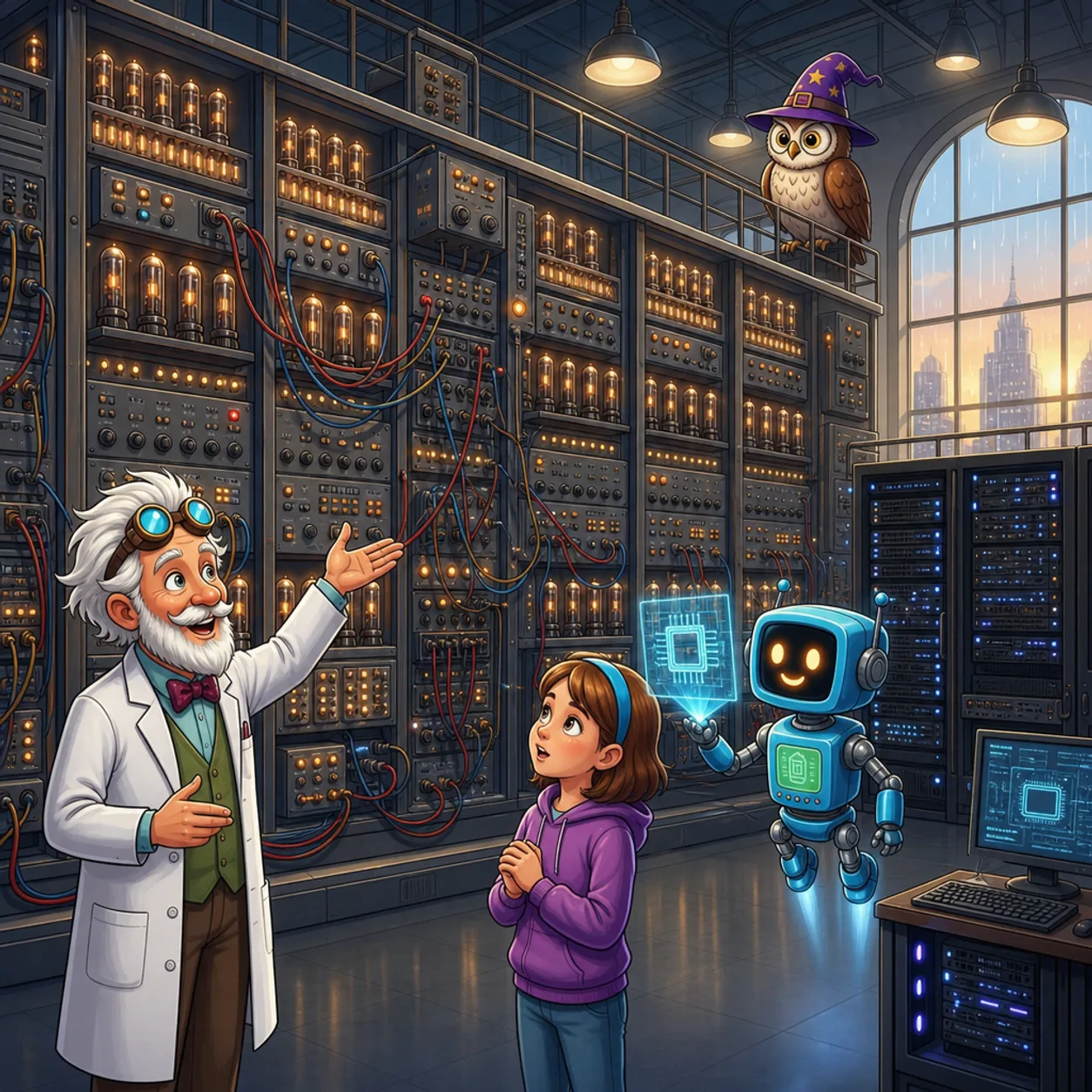
— Here we've reached the period when electricity met computation, — the Professor said. — The first fully electronic digital general-purpose computer is considered to be ENIAC (Electronic Numerical Integrator and Computer), created in 1945. It was enormous — occupied a room of 167 square meters and weighed 30 tons!
— That's huge! — Alice was surprised. — What could it do?
— By modern standards, not much, — the Professor smiled. — It was designed for calculating artillery firing tables during World War II. ENIAC could perform about 5000 addition operations per second — modern computers are billions of times faster.
— ENIAC used vacuum tubes as switches, — Byte added. — There were about 18,000 of them, and they often burned out. Technicians sometimes joked that when ENIAC was running, lights in Philadelphia dimmed due to the electricity it consumed.
— How were these first computers programmed? — Alice wondered.
— Programming ENIAC was extremely complex, — Logic replied. — To change a program, you had to physically switch wires and set switches. This work was often performed by female mathematicians called "computers." Their contribution to computer science development was long underestimated.
— An important breakthrough was the stored-program concept proposed by John von Neumann, — the Professor continued. — According to this idea, a computer program should be stored in computer memory just like data. This allowed changing programs much faster and easier.
They moved to the next section, where computers from the 1950s-60s were presented.
— In 1947, the transistor was invented — a semiconductor device that could replace vacuum tubes, — the Professor told. — Transistors were smaller, more reliable, and consumed less energy. This enabled creating second-generation computers in the 1950s.
— When did microprocessors appear? — Alice asked.
— The next revolutionary step was the invention of the integrated circuit, or microchip, in the late 1950s, — the Professor replied. — The integrated circuit allowed placing many transistors on a single silicon wafer. The first commercial microprocessor, Intel 4004, was released in 1971. It contained 2300 transistors.
— And how many transistors are in processors now? — Alice wondered.
— Modern processors can contain tens of billions of transistors, — Byte replied. — For comparison, the processor that controls me has about 2 billion transistors.
They approached a section dedicated to personal computers.
— Until the 1970s, computers were huge, expensive machines accessible only to large organizations, — the Professor continued. — But with the development of microelectronics, it became possible to create personal computers — machines small and affordable enough for ordinary people.
— One of the first successful personal computers was the Apple II, released in 1977, — Logic added. — And in 1981, IBM presented its Personal Computer (PC), which set the standard for subsequent generations of computers.
— At that time, computers weren't very powerful, — Byte noted. — The first IBM PC had a processor with a clock speed of 4.77 MHz and 16 KB of memory. For comparison, modern smartphones have processors with clock speeds over 2 GHz and memory of several gigabytes.
— When did the internet appear? — Alice asked.
— The history of the internet began in 1969 with the creation of ARPANET — a network connecting several universities and research centers in the USA, — the Professor replied. — But the internet became widespread in the 1990s with the emergence of the World Wide Web, created by Tim Berners-Lee.
— The internet radically changed how computers are used, — Logic added. — From isolated computing machines, they became nodes in a global network through which you can access vast amounts of information and interact with people worldwide.
They moved to the last section, dedicated to modern technologies and the future.
— Over recent decades, we've observed the miniaturization and increasing power of computers, — the Professor continued. — We've moved from desktop computers to laptops, tablets, and smartphones — devices you can carry with you.
— Now we're on the threshold of a new era, — Byte added. — The era of quantum computers, neuromorphic computers that mimic the human brain, and ubiquitous computing, when computers become part of everyday objects.
— How is computer development connected to artificial intelligence? — Alice asked.
— Good question! — the Professor smiled. — The history of artificial intelligence is closely intertwined with the history of computers. The very idea of creating machines capable of thinking existed long before electronic computers, but only with their invention did the technical possibility to realize this idea appear.
— The term "artificial intelligence" was proposed in 1956 at a conference at Dartmouth College, — Logic continued. — Since then, this field has experienced periods of enthusiasm and disappointment, called "AI spring" and "AI winter."
— But a real breakthrough happened in recent decades, — the Professor emphasized. — Increased computer processing power, the emergence of big data, and the development of new machine learning algorithms led to significant successes in areas like pattern recognition, natural language processing, computer vision.
— Especially important became the development of deep neural networks, — Byte added. — These are machine learning systems inspired by the structure of the human brain. They consist of many layers of artificial neurons and can learn from vast amounts of data.
— The history of computers is a history of constant innovation and overcoming limitations, — the Professor summarized. — From the abacus to quantum computers, from mechanical calculators to artificial intelligence systems — this is a path of continuous improvement and expanding capabilities.
— But it's important to remember, — Logic noted, — that behind every technological breakthrough are people — scientists, engineers, programmers, entrepreneurs. Technologies don't develop by themselves; they're driven forward by human knowledge, curiosity, and creativity.
— And you, Alice, — the Professor smiled, — are becoming part of this great history. Who knows, maybe you'll make the next important step in developing computers or artificial intelligence.