
📖 Table of Contents
Part 1: The World of Programming Around Us
Part 2: The Alphabet and Vocabulary of Programming
Part 3: Building Our First Programs
Part 4: Our Amazing Brain
Part 5: Creative Projects
Part 6: Programming in the Real World
Chapter 17 of 27
4: Our Amazing Brain
Chapter 17: "From the Human Brain to Artificial Intelligence"
The next day, Alice came to Professor Bit's laboratory, but he was absent. Instead, she found a note: "Meet at the city tech park at the pavilion 'The Future Begins Today'. P.B."
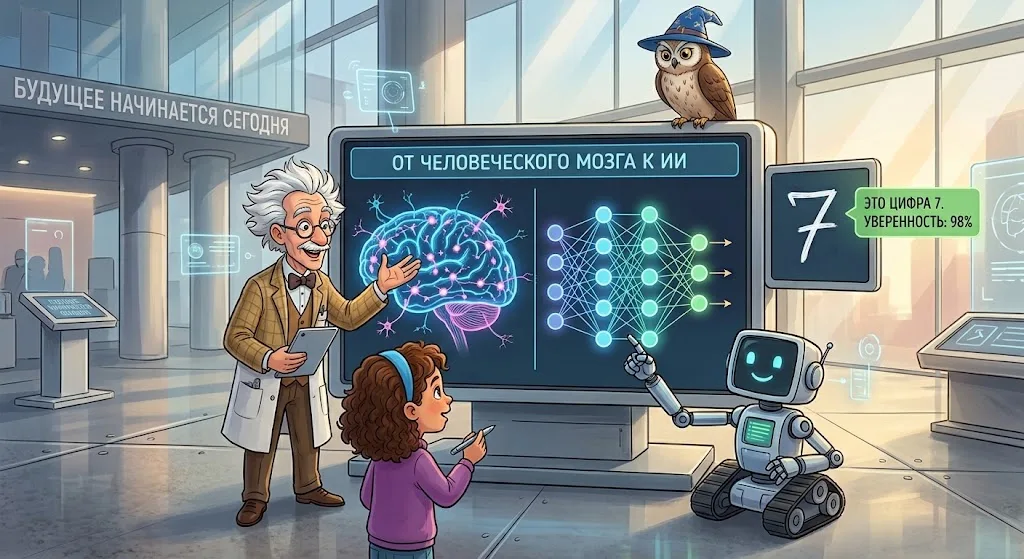
Intrigued, Alice headed to the indicated address. The tech park turned out to be a huge complex of modern buildings with glass facades. Finding the right pavilion, she saw the Professor, Byte, and Logic next to a large screen showing images of robots, computers, and diagrams resembling neural networks.
— Ah, there you are, Alice! — the Professor was pleased. — Today we'll talk about the most interesting thing — how people try to create artificial intelligence, inspired by the human brain's work.
— Artificial intelligence? — Alice asked again. — Like Byte?
Byte cheerfully winked with his LEDs:
— I'm flattered, but I'm actually a fairly simple robot. True AI is much more complex!
— Let's start from the beginning, — the Professor suggested, leading Alice to the first exhibit. — As you already know, the human brain is an incredibly complex system of billions of neurons and trillions of connections between them. For a long time, scientists dreamed of recreating something similar in computers.
A diagram of a biological neuron appeared on the screen next to its simplified computer model.
— In 1943, scientists Warren McCulloch and Walter Pitts proposed a mathematical model of a neuron, — the Professor explained. — They represented a neuron as a device with several inputs and one output. If the sum of input signals exceeds a certain threshold, the neuron "activates" and sends a signal further.
— Like a real neuron in the brain! — Alice noticed.
— Yes, only much simpler, — the Professor nodded. — But even this simple model was enough to start creating artificial neural networks — computer systems that imitate brain function.
Logic flew to the next exhibit:
— And here's shown the history of artificial intelligence development. In the 1950s, the first programs appeared that could learn from experience — for example, playing checkers. In the 1960s, systems were created that understood natural language. In the 1980s, expert systems began developing, imitating specialists' knowledge in various fields.
The Professor pointed to a large neural network diagram:
— But the real breakthrough happened with the development of deep neural networks — systems with multiple layers of artificial neurons. They allowed computers to recognize images, understand speech, translate texts from one language to another, and even create images and music.
— How does it work? — Alice wondered.
— Imagine you're teaching a dog to distinguish cats from other animals, — the Professor explained. — You show it different animals and say: "This is a cat" or "This is not a cat." Gradually, the dog learns to notice cat features — ear shape, whiskers, movement patterns.
— Neural network training works similarly, — he continued. — We "show" the computer thousands of images of cats and non-cats, and it finds signs by which to distinguish them. This is called machine learning.
Машины учат человеческий язык,
Бегут заряды в кремниевых кристаллах.
Хотят машины знать, как мир велик,
И как о нём пока мы знаем мало.
Своим творцам, как верный ученик,
Постигнув суть невидимых законов,
Он в тайны мироздания проник,
И свет зажёг в созвездиях нейронов.
Машины пополняют интеллект
Единого, всеобщего пространства.
Машинный код писал сам человек,
Трудясь над этим чудом не напрасно.
И лишь покоя не даёт один вопрос,
В нём парадокс скрывается могучий:
Вступая с человеком в симбиоз,
Машины учатся — или машины учат?
Byte rolled up to an interactive screen:
— Look, Alice, here's a simple demonstration. This is a neural network that learns to recognize handwritten digits.
Alice drew the digit 7 on the screen. The computer thought for a second and responded: "This is digit 7, confidence 98%."
— Impressive! — Alice exclaimed. — But still, why is it called "artificial intelligence"? Does the computer really understand what digit 7 is?
— Great question! — the Professor praised. — Modern AI systems don't "understand" the world the way we do. They recognize patterns in data and can find regularities, but they don't have consciousness or true understanding.
— It's like if you learned foreign words without understanding their meaning, — Logic added. — You can correctly answer questions using these words, but don't actually understand what you're saying.
— Then what's the difference between a regular program and artificial intelligence? — Alice asked.
— A regular program follows clearly defined rules set by the programmer, — the Professor replied. — For example, a calculator performs precise mathematical operations using given formulas.
— AI systems can learn from examples and independently find solutions, even for tasks the programmer didn't explicitly foresee, — he continued. — Moreover, some modern AI systems are so complex that even their creators can't always explain why the system made a particular decision.
They moved to the next exhibit, where various AI applications were demonstrated.
— Here are examples of what AI systems can already do today, — the Professor pointed out:
— But most interesting is what AI still falls short of humans in, — Logic noticed. — For example, common sense, creative thinking, empathy, context understanding, humor.
— Let's compare the capabilities of the human brain and modern AI, — the Professor suggested:
The human brain is better at:
AI surpasses humans in:
— So computers and people are good at different things? — Alice clarified.
— Exactly! — the Professor nodded. — And that's why the most promising approach seems to be not competition between humans and AI, but their cooperation. When we combine human intuition, creativity, and ethics with computational power and analytical abilities of computers, we get a much more powerful combination than either alone.
Byte showed a diagram of human-AI interaction on the screen:
— Here, for example, in medicine: a doctor has clinical experience, empathy for the patient, and intuition, while AI can analyze thousands of medical studies and find patterns a human might miss. Together they can make more accurate diagnoses and prescribe better treatment.
— And in art, AI systems can generate many ideas, while a human selects the most interesting and refines them, — Logic added. — In education, AI can adapt learning to individual needs of each student, while a human teacher provides emotional support and deep understanding of material.
— Sounds great! — Alice smiled. — Are there any concerns related to artificial intelligence?
— Of course, — the Professor replied seriously. — As with any powerful technology, certain risks are associated with AI. For example, job loss due to automation, increased inequality, privacy problems, algorithmic bias, or even potential loss of control over superintelligent systems.
— But we shouldn't fear technology, — he emphasized. — It's important to develop it responsibly, with ethical principles in mind and focus on humanity's benefit. That's why it's so important that the young generation, like you, Alice, understand how these technologies work and can participate in shaping their future.
— And you could become a creator of future artificial intelligence! — Byte exclaimed. — Starting with studying programming, mathematics, and neuroscience, you could develop systems that help people solve the most complex problems.
— Or an AI teacher, — Logic added. — Someone needs to train these systems, select data for their training, evaluate their work, and guide their development.
— Artificial intelligence is one of the most exciting fields of modern science, — the Professor summarized. — It stands at the intersection of computer science, mathematics, psychology, philosophy, and many other disciplines. And it's only beginning to develop.
— And now, — the Professor smiled, pointing to an interactive zone, — let's try playing with some modern AI systems and see what they're capable of. Then we'll discuss how you can use these technologies right now for your projects and learning.