
📖 Table of Contents
Part 1: The World of Programming Around Us
Part 2: The Alphabet and Vocabulary of Programming
Part 3: Building Our First Programs
Part 4: Our Amazing Brain
Part 5: Creative Projects
Part 6: Programming in the Real World
Chapter 5 of 27
2: The Alphabet and Vocabulary of Programming
Chapter 5: "Languages for Communicating with Computers"
In the morning, Alice woke up from strange sounds coming from the living room. When she came out of her room, she saw Byte making a series of beeping sounds, and Professor Bit seemed to understand him.
— Good morning, Alice! — the Professor turned to her. — Byte and I were just discussing the topic of today's lesson — programming languages.
— Were you speaking in robot language? — Alice wondered, pouring herself orange juice.
— Something like that, — the Professor smiled. — Byte was speaking in a language called "machine code." This is the lowest-level language that computers use to communicate internally.
Logic, sitting on a bookshelf, spread her wings:
— There are more than 700 programming languages in the world, and each has its own features and purpose.
— Seven hundred?! — Alice was surprised. — But why so many? People get by with far fewer languages for communication.
The Professor sat at the table and showed Alice his tablet:
— Look, programming languages are created for different purposes, just like tools. A hammer is good for driving nails, but not very convenient for screwing in screws, right?
Alice nodded.
— It's the same with programming languages. Some are good for creating websites, others — for analyzing data, others — for controlling robots or creating games.
A colorful diagram with different programming languages appeared on the screen.
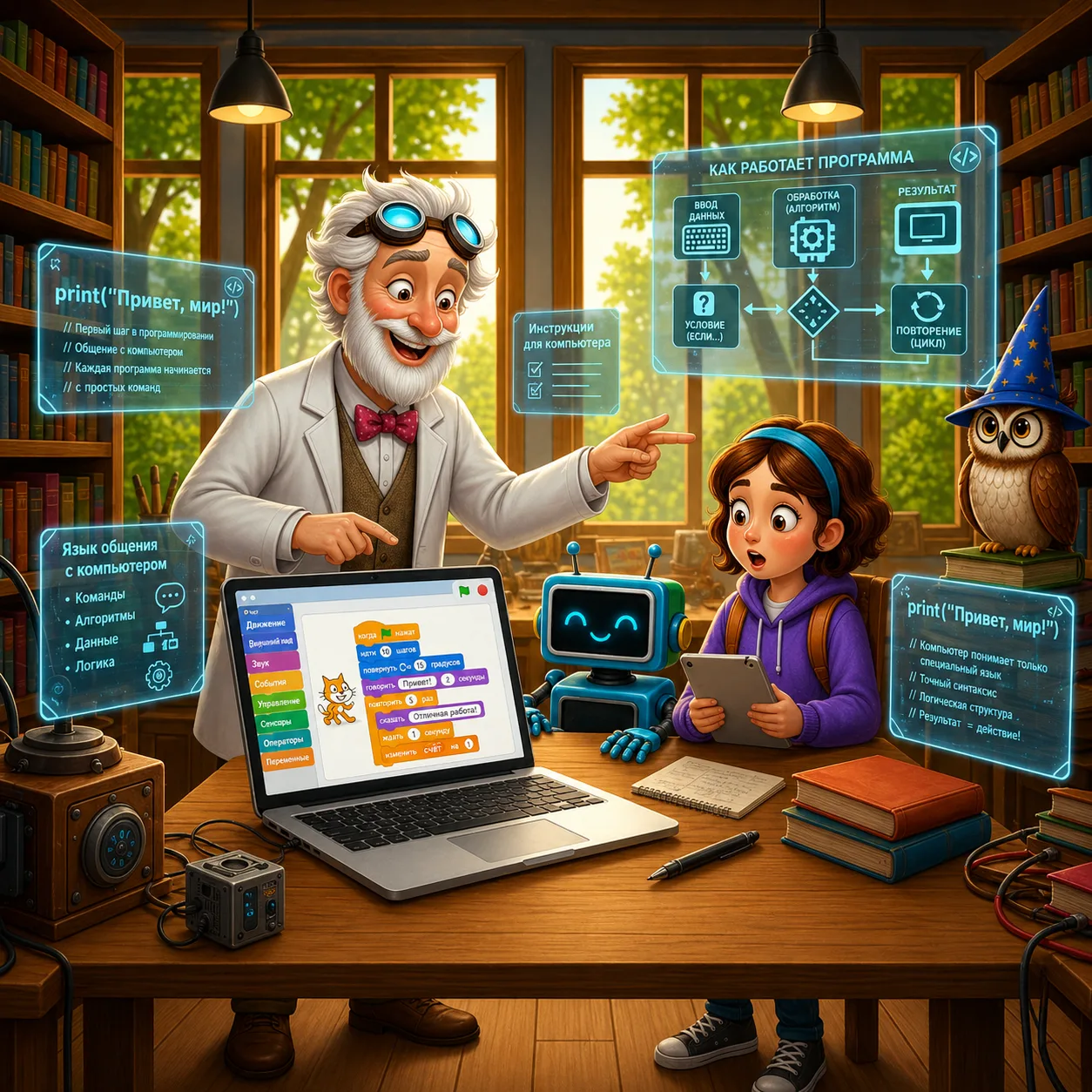
— Here, for example, Python, — the Professor pointed to a logo with a snake. — This is a very popular language, understandable for beginners. You can write almost anything on it — from simple scripts to complex scientific programs.
— And this is JavaScript, — the Professor pointed to another logo. — It controls most interactive elements on web pages.
— What language does Byte speak? — Alice asked.
— Byte has several languages, — the Professor replied. — His basic functions are written in C++, which is a very fast and powerful language. And for communicating with us, he uses special Python libraries.
Семьсот путей, семьсот дорог,
Семьсот сплетений точных строк.
Семьсот различных — про одно:
Как в цепь вплетается звено.
Для каждой цели — свой язык,
К которому творец привык.
Семьсот путей на высоту
Рождают в коде красоту.
Один, как флейта, ясен, чист,
Свободен, как летящий лист.
Другой — как молот, крепок, твёрд,
В расчётах точен, строг и горд.
Тот — архитектор важных дел,
Построить прочный свод сумел.
А этот — красочен и жив,
Как акварели перелив.
Вот страж табличной глубины,
Где ритмы строгие точны.
В бездонной памяти сетей —
Хранитель данных и ключей.
На разных языках народ
Творит симфонию из нот.
По-разному всё об одном:
Их код вплетается в геном!
— Professor, how are programming languages different from human languages? — Alice wondered.
— Great question! — The Professor thought for a moment. — The main difference is that human languages allow ambiguity and interpretation, while programming languages must be absolutely precise.
— What does that mean?
— When I say: "Please pass me that thing," — you can understand from context what I mean. If I glance at the TV remote, you'll guess that I need exactly that. But a computer can't "guess." If you don't specify exactly what needs to be done, it will either give an error or do something wrong.
Byte made a series of sounds like laughter:
— When programmers write imprecise instructions, funny results happen! Once I was asked to "go right when you see a tree." I never moved because it wasn't specified WHICH tree!
— Exactly! — the Professor continued. — In programming, extreme precision is important. The computer does exactly what you tell it, not what you mean.
Logic added:
— Human languages evolved over thousands of years, while programming languages were specifically created by people to solve specific tasks.
The Professor pulled several books from the shelf:
— Each programming language has its own syntax — a set of rules that determine how commands should be written. It's like grammar in regular languages.
He opened his laptop and showed a simple program:
python
print("Hello, world!")
— This is a program in Python, — he explained. — It displays the phrase "Hello, world!" on the screen. And here's the same thing in JavaScript:
jsx
console.log('Hello, world!');
— And here's in C++:
cpp
#include
int main() {
    std::cout << "Hello, world!" << std::endl;
    return 0;
}
— Do you see how differently you can say the same thing? — asked the Professor.
— Yes, Python looks the simplest, — Alice noticed.
— Well observed! — the Professor nodded. — Python was created with readability in mind. It's often recommended for beginners precisely because its code resembles regular English.
— What language should I learn to program? — Alice asked.
— To start, I'd recommend something visual, like Scratch, — the Professor replied. — In it, a program is assembled from blocks, like a LEGO constructor. This helps understand the basic concepts of programming without needing to memorize syntax.
Byte displayed a colorful Scratch interface on his screen:
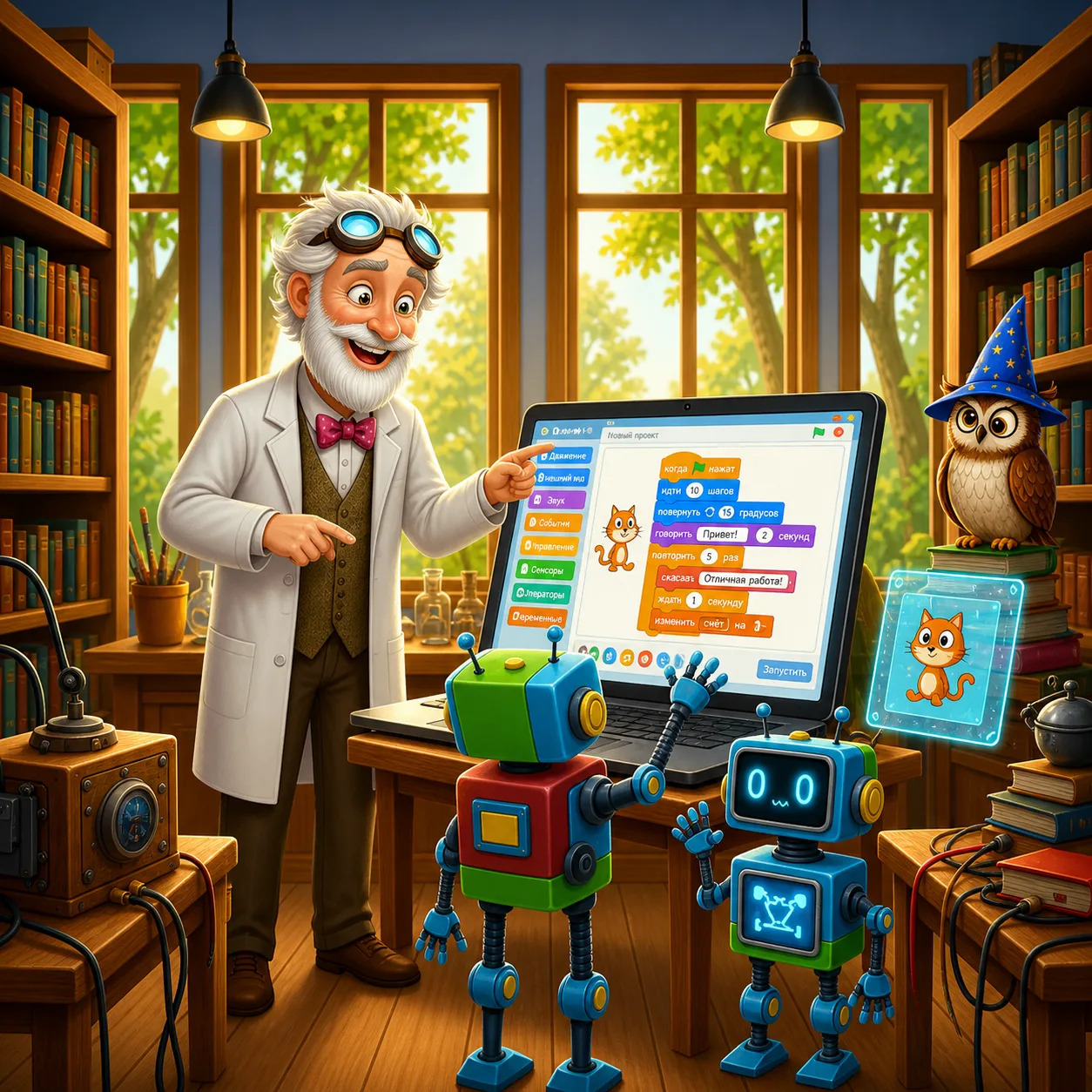
— Look, this is what a program looks like in Scratch. You drag command blocks, connect them, and you get a program!
— Looks like a game, — Alice smiled.
— Programming should be engaging! — the Professor winked. — Many professional programmers say their work is like solving puzzles and creating something new at the same time.