
📖 Table of Contents
Part 1: The World of Programming Around Us
Part 2: The Alphabet and Vocabulary of Programming
Part 3: Building Our First Programs
Part 4: Our Amazing Brain
Part 5: Creative Projects
Part 6: Programming in the Real World
Chapter 16 of 27
4: Our Amazing Brain
Chapter 16: "How to Develop Your Brain"
It was Saturday, and Professor Bit invited Alice to his laboratory for a special experiment. When she entered, she saw several strange devices and an entire wall filled with various items: musical instruments, puzzles, books in different languages, and some incomprehensible devices.
— Welcome to the brain gym! — the Professor announced with a smile. — Today we'll talk about how to develop your most important organ.

— I thought the most important organ is the heart, — Alice was surprised.
— All organs are important, — Logic, sitting on a bookshelf, replied, — but it's the brain that makes us who we are. It's responsible for our thoughts, feelings, memories, creativity — everything that makes up our personality.
— And like any muscle, the brain needs training, — the Professor added. — Otherwise it can "weaken."
— The brain is not a muscle, Professor, — Logic corrected.
— Technically, yes, — the Professor nodded. — But the analogy is good: the more you train your brain, the better it works. And conversely, without use, its functions can deteriorate.
Зачем учиться
А зачем все это нужно мне?
Тяжкое, труднейшее учение…
Чтоб превозмогая грусть и гнев
Жизнь прожечь как полымя, - в огне
Предавая радость и стремление
От того, что стану я умней
Стану ли я лучше и счастливей?
Разбросать бесчисленно камней…
Вот разумность - что мне делать с ней?
Стоит ли она дороже лилий?
Может, это слишком трудный путь,
Дорого потраченное время.
В жизни лучше плыть, а не тонуть –
Ведь еще не поздно повернуть,
Сбросить груз и обучения бремя.
Сразу станет просто и легко,
Без заумных терминов научных
Не придется прыгать высоко…
Но сидеть, как бабушка с клюкой, -
Мне, возможно, станет очень скучно
— How do you train the brain? — Alice asked. — I've seen dad lift dumbbells for muscles, but how do you lift "dumbbells" for the brain?
The Professor approached a table where several puzzles lay:
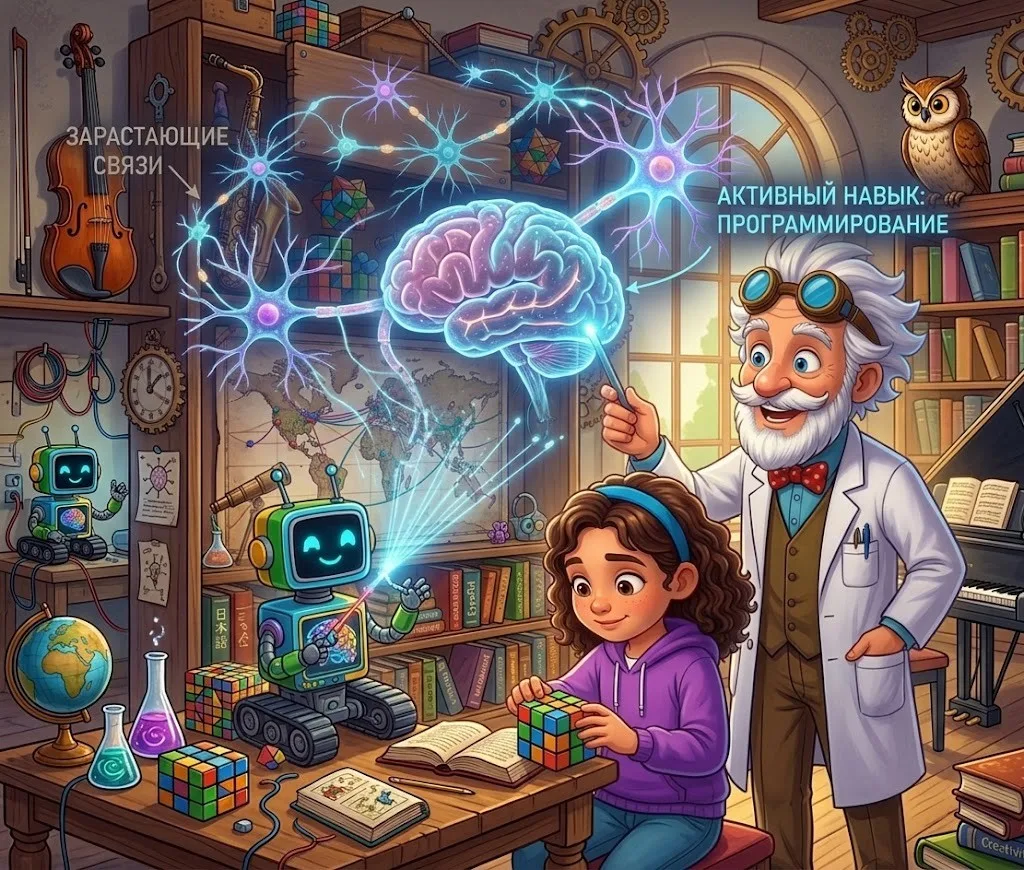
— The brain loves new tasks and challenges. When you encounter something new and complex, new neural connections form in your brain. This is called neurogenesis and synaptogenesis — creating new neurons and connections between them.
Byte showed an animation on his screen where new connections stretched from one neuron to another:
— Every time you learn something new, something like this happens. Imagine your brain is a dense forest, and thoughts and skills are paths in this forest. The more often you "walk" a certain route, the wider and more noticeable the path becomes.
— What develops the brain best? — Alice wondered.
— There are several especially effective types of activities, — the Professor replied. — First, learning foreign languages. It engages various brain zones and creates new connections between them.
— Is it true that children learn languages easier than adults? — Alice asked.
— Yes, — the Professor nodded. — Up to a certain age, roughly 7-10 years, a child's brain is in a "critical period" for language learning. At this time, the brain is especially sensitive to language patterns, intonations, grammatical structures. That's why children growing up in a bilingual environment easily master both languages without an accent.
Logic added:
— But this doesn't mean adults can't learn a new language! They just need more conscious effort and practice.
— What else is useful for the brain? — Alice asked.
— Music! — the Professor exclaimed and pointed to a piano in the corner of the room. — Playing musical instruments is one of the most complex activities for the brain. It engages the motor cortex (finger control), auditory cortex (sound perception), visual cortex (reading notes), frontal lobes (planning action sequences), cerebellum (movement coordination), and even emotional centers.
— Musicians often show better results in memory, attention, and mathematical ability tests, — Logic noticed. — Their brain literally "restructures" under the influence of musical practice.
— What about video games? — Alice asked hopefully. — Are they good for the brain?
— It depends on the type of game, — the Professor replied. — Some games, especially strategies and puzzles, train logical thinking, planning, memory, and attention. But it's important to maintain balance and not spend too much time on games.
Byte rolled up to a bookshelf:
— Reading also excellently stimulates the brain! Especially fiction, which develops empathy and emotional intelligence. When you read about characters' adventures, your brain activates the same zones as if you were experiencing those events yourself.
— What about physical exercise? — Alice asked. — They're for muscles, not the brain, right?
— Actually, regular physical activity is incredibly beneficial for the brain, — the Professor objected. — Exercise increases blood circulation, delivering more oxygen and nutrients to the brain. They also stimulate production of special proteins that support neuron health and promote formation of new connections.
— Even a simple daily walk significantly improves cognitive functions, — Logic added. — And exercises requiring coordination, like dancing or martial arts, additionally stimulate cerebellum and motor cortex development.
The Professor approached a large world map on the wall:
— Another powerful brain stimulator is travel and new experiences. When you find yourself in an unfamiliar place, your brain literally "wakes up." New sounds, smells, sights, language, culture — all of this creates a rich sensory environment that stimulates the brain to create new neural connections.
— That's why people often say that travel "broadens horizons"? — Alice asked.
— Exactly! — the Professor nodded. — And this is literally true: your brain physically changes, creating new connections when you get diverse experiences.
— What else is important for brain health? — Alice wondered.
— Sleep! — the Professor and Logic answered in unison.
— Adequate and quality sleep is critically important for the brain, — the Professor explained. — During sleep, the brain doesn't just rest, but performs important work: strengthening new neural connections, "transferring" information from short-term to long-term memory, removing toxins.
— If you don't get enough sleep, — Logic added, — all cognitive functions suffer: attention, memory, problem-solving ability, emotion control.
— And healthy nutrition is also important for the brain, — the Professor noticed. — The brain consumes about 20% of all body energy, though it's only 2% of body mass. It needs proteins, healthy fats (especially Omega-3), antioxidants, vitamins, and minerals.
Byte displayed a list of brain-healthy foods on his screen:
— Fatty fish, nuts, berries, leafy green vegetables, whole grains, olive oil, dark chocolate — all of this helps your brain work better!
— What did you mean when you said small children learn faster? — Alice asked.
— A child's brain is in a state of intensive development, — the Professor explained. — In the first years of life, trillions of neural connections form — many more than will be used in adult life.
— A child's brain is like a dense forest with many paths, — Logic added. — Over time, some of these paths become wide roads (frequently used skills), while others become overgrown (unused connections).
— This process is called "neural pruning," — the Professor continued. — The brain optimizes its work, preserving useful connections and getting rid of unused ones. This is a normal and necessary process.
— That's why it's so important to get diverse experiences from childhood, — Logic summarized. — Music, languages, sports, creativity — all of this creates a rich neural network that will serve as a foundation for further learning.
The Professor looked at Alice:
— You're already doing many things that are good for your brain. Learning programming, for example, develops logical thinking, problem-solving ability, attention to detail. But remember, the brain also needs variety!
— As neurobiologists say: "Neurons that fire together, wire together" — Logic said. — Every new experience, every new task creates new connections in your brain.
— And most amazing, — the Professor added, — this ability of the brain to learn and change persists throughout life. Even in old age, the brain can create new neural connections and adapt to new conditions.
— So we can develop our brain our whole life? — Alice clarified.
— Absolutely! — the Professor confirmed. — The main thing is to continue learning new things, solving complex problems, getting diverse experiences. And, of course, take care of brain health: sleep well, eat right, move.