
📖 Table of Contents
Part 1: The World of Programming Around Us
Part 2: The Alphabet and Vocabulary of Programming
Part 3: Building Our First Programs
Part 4: Our Amazing Brain
Part 5: Creative Projects
Part 6: Programming in the Real World
Chapter 27 of 27
7: From Electricity to AI
Chapter 27: "The Future with Artificial Intelligence"
It was a warm Saturday when Professor Bit organized an unusual meeting at the city tech park. He invited Alice, Byte, and Logic to an open panel discussion "The Future with Artificial Intelligence." Among the discussion participants were scientists, entrepreneurs, ethicists, science fiction writers — people looking at AI from different perspectives.
When they entered the spacious hall, Alice saw many interactive stands demonstrating the latest AI technologies. Young visitors were drawing with an AI artist, talking with virtual characters, watching robots that were learning new skills in real time.
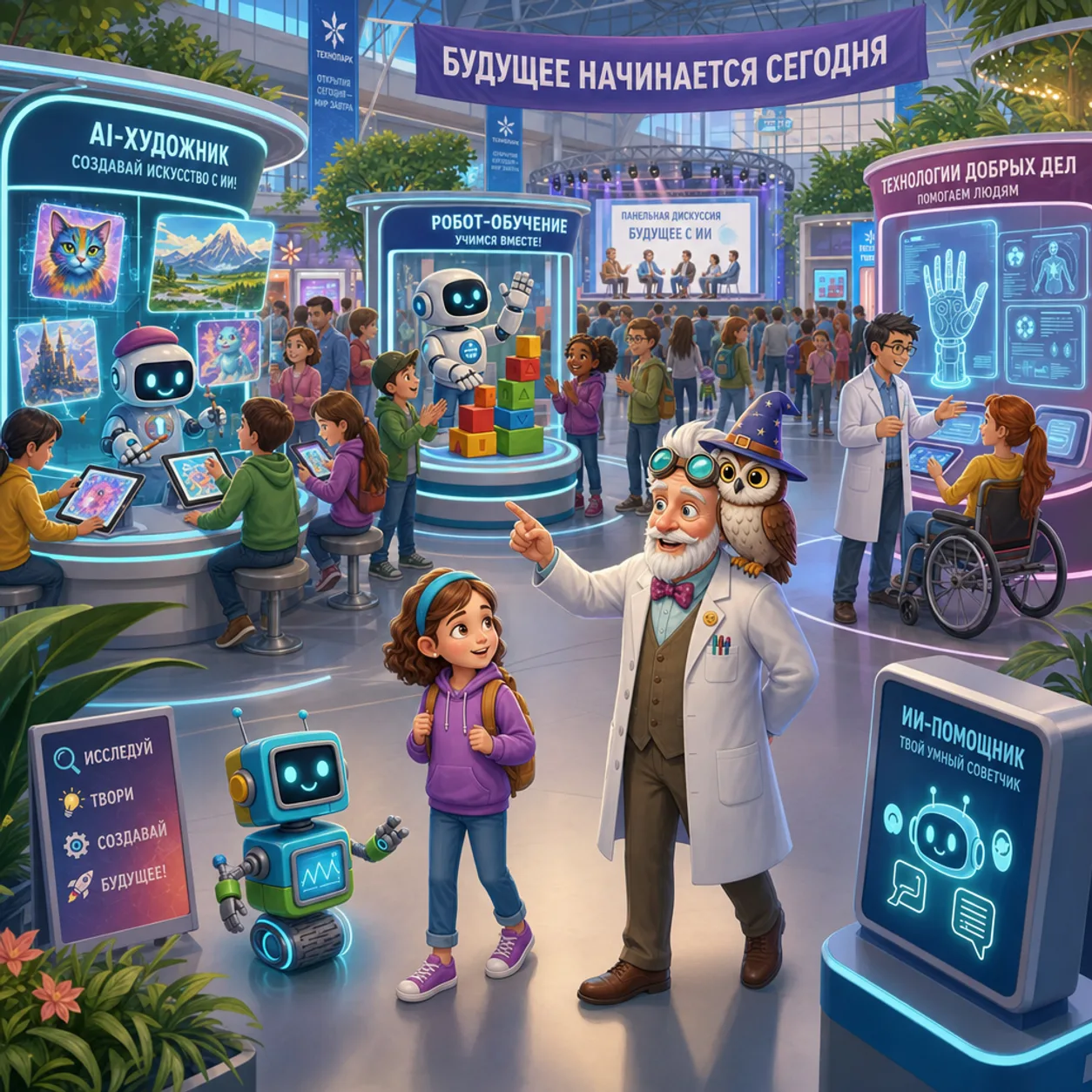
— Impressive, right? — the Professor asked. — And just ten years ago, most of these technologies seemed like science fiction.
She quietly added:
То, что раньше было в сказке,
Мы вместили в микрочип.
Мир меняет ритм и краски,
Строя новый прототип.
Там, где раньше для ответа
Люди ждали целый век,
Суть быстрее вспышки света
Получает человек!
То, о чём в своих романах
Мы мечтали сотни раз,
Оказалось ярче планов
И ошеломило нас!
After viewing the exhibition, they took seats in the auditorium, where the discussion soon began.
— Good afternoon, dear guests! — the moderator, a middle-aged woman in an elegant suit, began. — Today we'll discuss what our future with artificial intelligence might be like. How will these technologies change our lives in the coming years and decades? What opportunities do they open and what challenges do they create?
First to speak was a gray-haired professor of neuroscience:
— We're on the threshold of revolutionary changes in understanding the human brain, — he began. — Artificial intelligence helps us decode neural connections, model brain activity, understand mechanisms of memory, learning, emotions. This opens the way to treating neurodegenerative diseases like Alzheimer's or Parkinson's, creating neural interfaces for people with disabilities, developing new learning methods.
Next, a young woman, a medical technology specialist, took the floor:
— Already now, AI helps diagnose diseases at early stages, analyzing medical images with accuracy surpassing experienced doctors. In the future, personalized medicine based on AI will be able to select treatments considering each patient's genetic characteristics. Robot surgeons perform surgeries with incredible precision. Smart implants and prostheses controlled by neural interfaces restore lost functions to people.
— And how will artificial intelligence affect education? — the moderator asked.
— Education will become truly personalized, — an innovative educator replied. — AI tutors will be able to adapt the pace, style, and content of learning to each student, identify and eliminate knowledge gaps, maintain motivation. Virtual and augmented reality with AI will allow creating amazing interactive lessons: traveling through ancient civilizations, diving inside a living cell, conducting virtual experiments.
— At the same time, the role of the human teacher remains critically important, — he emphasized. — But it will change: fewer routine tasks, more creativity, mentoring, developing emotional intelligence and critical thinking — things where people still surpass machines.
Next, a transportation expert spoke:
— In the coming decades, we'll see a revolution in the transportation system. Autonomous electric cars will reduce accidents, decrease traffic jams and air pollution. Smart transportation networks will optimize routes and schedules. Unmanned aerial vehicles — from small delivery drones to air taxis — will relieve ground infrastructure.
— Will robots really replace many professions? — the moderator asked, addressing a labor market specialist.
— Automation and AI will indeed change the job market, but this isn't the first time in history that technologies have transformed the economy, — he replied. — Some professions will disappear, but new ones will appear. Routine, repetitive tasks will be automated, but the value of creativity, emotional intelligence, critical thinking, teamwork will grow.
— Probably the very concept of work will change, — he continued. — We may see a reduction in the work week, growth in part-time employment and freelancing, new models of benefit distribution such as universal basic income.
— There's an opinion that artificial intelligence can help solve humanity's global problems, — the moderator noted. — Is this really true?
— AI already helps fight climate change, — a climatologist replied. — It optimizes energy consumption, predicts weather phenomena, models climate scenarios. Smart power grids balance energy production and consumption, integrating renewable sources. Precision agriculture systems reduce water, fertilizer, and pesticide use.
— In biodiversity conservation, AI helps track species populations, predict effects of habitat changes, combat poaching, — she added. — In the coming decades, these technologies may play a decisive role in preventing climate catastrophe.
Next, an AI ethics specialist spoke:
— With all these amazing possibilities, we must remember important ethical questions. How to ensure AI is fair and doesn't discriminate against certain groups? How to protect privacy in a world of ubiquitous smart devices? Who is responsible for decisions made by autonomous systems? How to distribute benefits from new technologies?
— We must develop human-value-oriented AI, — he emphasized. — Technologies should serve people, not vice versa. For this, it's necessary to include diverse voices in the process of developing and regulating AI, create systems that explain their decisions, conduct social impact assessments of new technologies.
After the main presentations, a discussion began in which audience members also participated.
— What about concerns that superintelligent AI might get out of control? — someone from the audience asked.
— This is an important question, — an AI safety researcher replied. — Although scenarios from movies with killer robots are unlikely, real risks exist associated with developing powerful AI systems: unforeseen consequences of goal optimization, possibility of AI being used by malicious actors, loss of human control over critical systems.
— That's why it's so important to research methods for creating reliable, verifiable, human-value-oriented AI, — he continued. — This includes developing technical solutions for ensuring safety, as well as creating international standards and agreements.
After the discussion, Alice looked thoughtfully out the window, watching passing cars.
— What are you thinking about? — the Professor asked.
— About all this future, — she replied. — It seems so exciting and a bit frightening at the same time.
— That's a normal reaction, — the Professor smiled. — New technologies have always evoked mixed feelings. When steam locomotives appeared, people feared the human body couldn't withstand such speed. When the telephone was invented, there were concerns it would destroy personal communication.
— The future isn't predetermined, — Logic added. — It depends on decisions we make today. It's important not just to follow technologies, but to guide their development in accordance with our values and priorities.
— And what professions might appear in a world where AI becomes increasingly widespread? — Alice wondered.
— Oh, there could be many! — Byte perked up. — Here are some possible options:
1. AI Teacher — a specialist who "educates" AI systems, teaches them ethical principles, checks their decisions.
2. Explainable AI Engineer — develops systems that can explain their decisions in ways understandable to people.
3. Ethical Data Specialist — ensures data used for training AI is fair, diverse, and protects privacy.
4. AI Creative Partner — an artist, writer, or designer working in partnership with AI to create new artworks.
5. Human-AI Translator — helps people effectively interact with AI systems and understand their capabilities and limitations.
6. Algorithm Auditor — checks AI systems for bias, errors, or vulnerabilities.
7. AI Psychologist — analyzes behavior of complex AI systems, identifies and fixes problems in their "thinking."
8. Human-AI Fusion Expert — develops and tunes neural interfaces and other technologies for effective human-machine interaction.
— Sounds fascinating! — Alice exclaimed. — And what would you like to be in such a future?
— I'd be happy to be a teacher and mentor for new generations of AI, — the Professor replied thoughtfully. — Help them learn from humanity and develop in the right direction.
— And I'd organize dialogues between people and AI systems, — Logic noted. — Help find common language and solve problems together.
— And I already work as a bridge between technologies and people! — Byte joyfully jumped. — And I'd like to develop in this direction!
They left the tech park and headed to a small cafe nearby. Over tea and pastries, the conversation continued.
— You know, Alice, — the Professor said, — it's important to remember that technologies are just tools. By themselves, they're neither good nor bad. Everything depends on how we use them, what goals we pursue.
— And on what values we embed in them, — Logic added. — Technical development should go hand in hand with ethical and philosophical reflection.
— And it's also important that technologies serve all people, not just the chosen few, — Byte noted. — So their benefits are accessible to everyone, regardless of social status, location, education.
— That's exactly why it's so important that the young generation, like you, Alice, not only understand how these technologies work but also think about what kind of world we want to create with their help, — the Professor emphasized.
— And what if AI someday becomes intelligent? Truly intelligent, like a human? — Alice asked.
— This is one of the deepest philosophical questions of our time, — the Professor smiled. — Could an artificial system possess consciousness, subjective experience, true understanding?
— Some scientists believe this is fundamentally impossible, — Logic noted. — Others think it's a matter of time and level of complexity.
— If such systems appear, new ethical questions will arise, — the Professor continued. — What status should intelligent AI have? What rights and responsibilities should they have? How will relationships between humans and AI be built?
— This sounds a bit like science fiction, — Alice smiled.
— Today's science fiction often becomes tomorrow's reality, — Byte winked. — Many modern technologies once existed only in books and movies.
— The future with artificial intelligence will be what we create, — the Professor summarized. — And there's something amazing and inspiring in this. We're not just observers, but active participants in shaping this future.
— And I'm glad you, Alice, are now also part of this process, — he added with a smile. — You know the basics of programming, understand how computers and artificial intelligence work. You can not only use technologies but also create them, guide their development.
— Thank you all, — Alice said sincerely. — For knowledge, for inspiration, for opening this amazing world to me.
The sun was setting, coloring the sky in orange and pink tones. They sat in the cafe, watched the city gradually lighting up, and thought about the future — the future they're helping to create.