
📖 Table of Contents
Part 1: The World of Programming Around Us
Part 2: The Alphabet and Vocabulary of Programming
Part 3: Building Our First Programs
Part 4: Our Amazing Brain
Part 5: Creative Projects
Part 6: Programming in the Real World
Chapter 21 of 27
6: Programming in the Real World
Chapter 21: "How Programs Change the World"
On Sunday morning, Professor Bit called Alice with an unusual proposal:
— Hello, Alice! How about a little trip? Today I want to show you how programming is used in the real world.
An hour later, Alice, the Professor, Byte, and Logic were already riding in the Professor's electric car.
— Where are we heading? — Alice asked curiously.
— We have several stops planned, — the Professor replied. — The first one is the city hospital. My former student Elena now works there as head of the IT department.
Он верил в простое, земное, живое,
В рассветы, в росу и дыханье лесов.
Считал: человек без стального покроя
Отыщет дорогу к душе без оков.
Он прятал свой взгляд от экранов и света,
Считал — в них обман и бессмысленный звон.
Но случай настиг его, словно комета:
Однажды в тиши зазвонил телефон.
Пробился сигнал, и барьер разорвался —
Мир ожил, и в гуле машин и сетей
Он искру тепла разглядеть догадался,
И души людей среди умных вещей.
Теперь он живёт, где природа и схемы
Сливаются в новый, прекрасный мотив.
Он с лёгкостью рушит пустые системы,
В машинные строки тепло поместив.
Soon they arrived at a modern hospital building. A young woman in a business suit met them at the entrance.
— Professor! So glad to see you, — Elena smiled, then turned to Alice: — And you must be the Professor's new student? He mentioned you're interested in programming.
— Elena, please show us how computer systems are used in the hospital, — the Professor asked.
— With pleasure, — Elena nodded and led them to the server room, where racks of equipment stood. — The entire hospital works as a single organism thanks to software. We have:
— What does the image analysis system do? — Alice wondered.
Elena led them to a radiologist's workstation:
— Look, when an X-ray or MRI is taken, a special program with artificial intelligence analyzes the image and helps the doctor find potential problems. The program was trained on millions of images and can notice details that a human might miss.
— So, does the program replace the doctor? — Alice asked.
— No, — Elena shook her head. — It helps the doctor, but the final decision is always made by a human. The program acts as a smart assistant, highlighting suspicious areas and suggesting possible interpretations.
Logic added:
— This is an example of augmented intelligence — a combination of human experience and machine algorithms. Together they achieve better results than separately.
— And here's our pride, — Elena pointed to a courier robot that was driving autonomously down the corridor. — This is an autonomous robot for delivering medications and materials. It knows the hospital layout, can call the elevator, avoid obstacles, and even interact with staff and patients.
— And all of this is programmed? — Alice was surprised.
— Yes, — Elena confirmed. — A team of programmers created a complex system that allows the robot to navigate space, perform tasks, and safely interact with people.
— Programs in healthcare literally save lives, — the Professor summarized. — They help make more accurate diagnoses, develop new medications, make surgeries safer and more effective.
After saying goodbye to Elena, they headed to the next stop — a modern farm on the outskirts of the city.
— Many think that agriculture is something traditional and not related to high technology, — the Professor said on the way. — But that's not true at all!
At the farm, they were met by a young man in jeans and a plaid shirt with a tablet in his hands.
— This is Mikhail, my former student, — the Professor introduced him. — He applies his programming knowledge in agriculture.
— Welcome to our smart farm! — Mikhail smiled. — We use technology to increase crop yields and reduce negative impact on the environment.
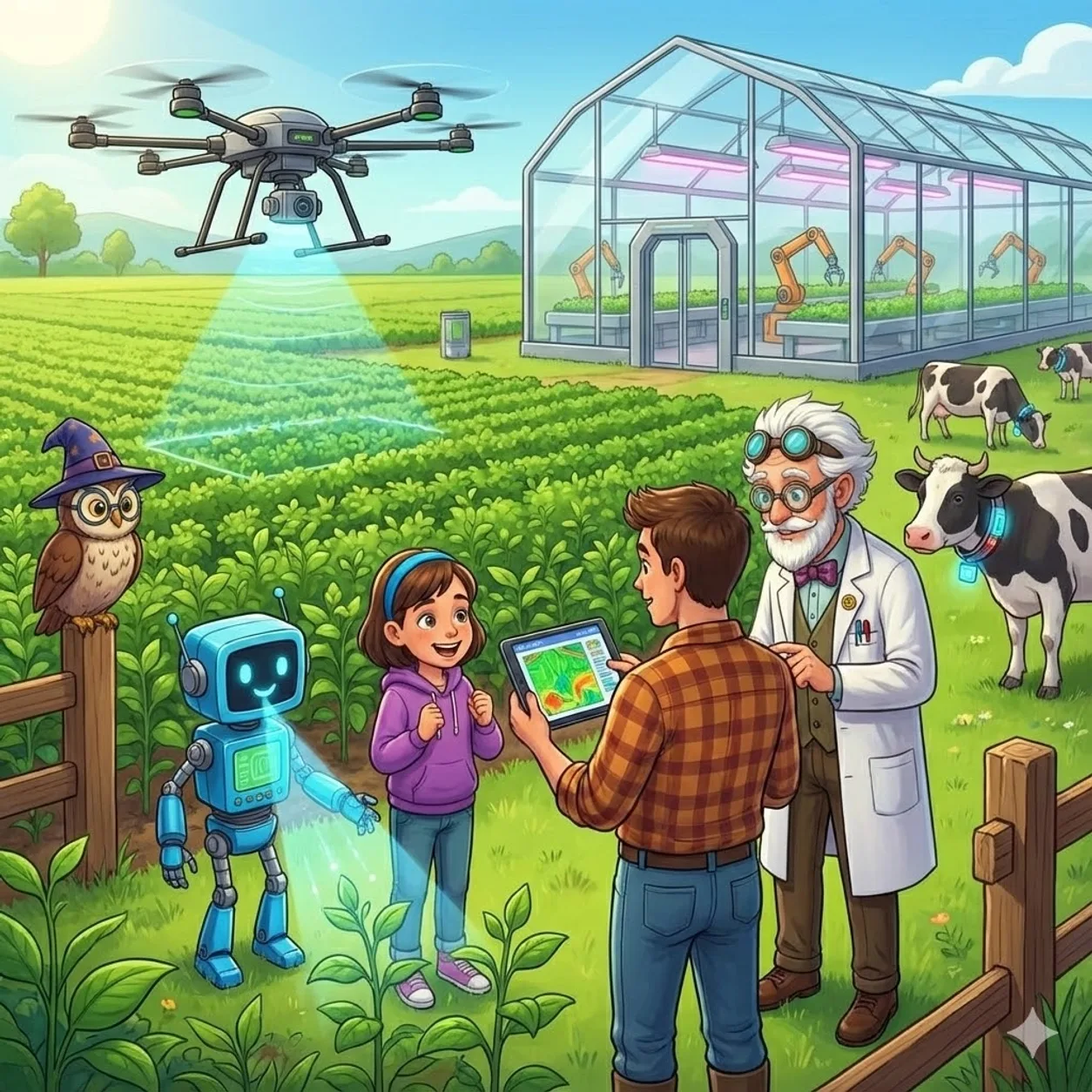
He showed them a field with a drone flying overhead:
— This drone is equipped with a multispectral camera. It photographs fields in different light spectra, and a special program analyzes the images and creates plant health maps. We can determine which areas lack moisture or nutrients, where there are pests or diseases.
— What do you do with this information? — Alice asked.
— Based on it, our automatic irrigation and fertilization system precisely calculates how much water and fertilizer each field area needs, — Mikhail explained. — This is called "precision agriculture." We save resources and get better yields.
Then Mikhail showed them a fully automated greenhouse:
— Here a computer controls temperature, humidity, lighting, irrigation, and CO₂ levels. Algorithms determine optimal conditions for each crop and automatically maintain them.
— And here's our herd, — Mikhail pointed to grazing cows. — Each cow wears a smart collar with sensors that transmit information about its health, activity, and location. A program analyzes this data and warns us about potential health problems even before obvious symptoms appear.
— It's like fitness trackers for people, — Alice noticed.
— Great comparison! — Mikhail smiled. — And the operating principle is really similar.
— We even use artificial intelligence to predict weather on our territory, considering local features, — he added. — This helps us plan field work and protect crops from bad weather.
After the farm, the Professor drove Alice to the city traffic control center.
— Here all the city's traffic lights are coordinated, — the center's engineer explained. — Previously, traffic lights worked on a fixed schedule, but now our system analyzes data from cameras and sensors in real time and adapts traffic light operation to current road conditions.
— So, if there are many cars on one street and few on another, the system will give a green light where there are more cars? — Alice clarified.
— Exactly! — the engineer confirmed. — Moreover, the system can create a "green wave" — a sequence of green signals allowing cars to pass through several intersections without stopping.
— How does the system know how many cars are on the street? — Alice wondered.
— We have several data sources, — the engineer replied. — Cameras with computer vision that recognize and count vehicles; sensors embedded in the road surface; data from GPS-equipped cars. All this information is processed in real time, and our algorithms make decisions about switching traffic lights.
— This reduces traffic jams and travel time by 15-30%, and also decreases exhaust emissions, — the Professor added.
The next stop was a modern environmental monitoring center.
— Here programs help track and protect the environment, — the Professor explained as they walked to the building.
Inside, the center's director met them and showed them a city map on a large screen:
— Our system collects data from hundreds of sensors located throughout the city and surrounding areas. They measure air quality, water quality, noise levels, radiation, and many other parameters.
She clicked on one of the points on the map, and detailed information about air quality in that area appeared on the screen.
— We also use satellite data and drones to monitor forests, — she continued. — Computer vision algorithms help detect illegal logging, fires at early stages, and changes in ecosystems.
— What about water bodies? — Alice asked.
— We have autonomous floating robots that collect water quality data, — the director replied. — They can detect pollution and its sources.
— All this data not only helps us monitor the state of nature but also create models that predict environmental changes, — she added. — For example, we can predict how climate change will affect local ecosystems or how a new factory might affect air quality in the area.
After the environmental center, they visited several more places: a modern school with interactive educational programs, an art museum where technology helps preserve and restore artworks, and an emergency response center where algorithms help coordinate rescue operations.
By evening, when they were returning home, Alice was full of impressions.
— I had no idea that programming is used in so many different areas! — she exclaimed. — It's not just games and websites.
— Programming is a universal tool for solving problems, — the Professor smiled. — It helps people in all spheres of life.
— What other areas didn't we see? — Alice wondered.
— Oh, there are many, — the Professor replied. — Here are some examples:
1. Science — analyzing data from particle accelerators, decoding genomes, climate modeling, searching for new medications
2. Finance — banking systems, trading algorithms, risk analysis, fighting fraud
3. Entertainment industry — special effects in movies, creating video games, music and video streaming services
4. Transportation — self-driving cars, route optimization, air traffic control
5. Energy — smart electrical grids, optimizing energy consumption, managing renewable sources
6. Artificial intelligence — speech and image recognition, translations, content creation, decision support
— But most importantly, — Logic added, — programs are created by people to solve human problems. Behind every line of code is a desire to make the world better, safer, healthier, more convenient.
Byte nodded:
— Exactly! Programming isn't just a technical discipline; it's a way to bring ideas to life.
— In which areas does programming change the world the most? — Alice wondered.
— Perhaps the most revolutionary changes happen where programs work with large volumes of data, — the Professor replied. — For example, in medicine, analyzing genetic data helps create personalized treatment methods. In ecology — predicting climate changes and finding ways to mitigate their consequences. In education — adapting learning to each student's needs.
— Are there any problems related to the widespread use of programs? — Alice asked.
— Great question, — the Professor nodded seriously. — Like any powerful technology, programming carries responsibility. Here are some challenges:
1. Data privacy and security — programs collect and process huge volumes of personal information
2. Automation and jobs — some professions may disappear due to automation
3. Algorithmic bias — programs may unconsciously reproduce existing prejudices
4. Digital inequality — not everyone has equal access to technology
5. Dependence on technology — what happens if systems break down?
6. Ethical questions — especially in areas related to artificial intelligence
— That's why it's so important for programmers to be aware of their responsibility, — Logic emphasized. — We need to not only ask "Can we do this?" but also "Should we do this? What will be the consequences?"
— How can we use programming to solve humanity's most important problems? — Alice asked.
The Professor smiled:
— There are many initiatives in this direction. For example, programs for:
— Many programmers participate in the "Tech for Good" movement, — Byte added. — They use their skills to solve social and environmental problems.
In the evening, already at home, Alice sat at the table, drawing in a notebook.
— What are you doing? — the Professor asked.
— I'm thinking up a program that could help solve the problem of plastic waste in the ocean, — Alice replied. — Maybe an algorithm for managing garbage-collecting robots or a system for tracking pollution sources.
The Professor looked at her with a smile:
— You know, the most wonderful thing about programming is that with its help, even one person can create something that changes millions of lives. Never underestimate the power of a good idea embodied in code.