
📖 Table of Contents
Part 1: The World of Programming Around Us
Part 2: The Alphabet and Vocabulary of Programming
Part 3: Building Our First Programs
Part 4: Our Amazing Brain
Part 5: Creative Projects
Part 6: Programming in the Real World
Chapter 26 of 27
7: From Electricity to AI
Chapter 26: "What is Artificial Intelligence"
The next day, Alice came to Professor Bit with many questions about artificial intelligence. She had read about it in the news, heard adults talking, seen mentions in movies and games, but didn't quite understand what it actually is.
The Professor, Byte, and Logic were happy about her curiosity and decided to arrange a special lesson dedicated to artificial intelligence.
— Let's start with a basic question, — the Professor suggested when they all gathered in his cozy office. — What is artificial intelligence?
He paused for a moment and quietly read:
Программа раньше строилась сурово:
Приказ, строка и строгий алгоритм.
Но мы машине подарили слово,
И вот она по-новому творит.
Она уже не следует шаблонам,
А ищет связи, учится, растёт,
И по незримым цифровым законам
Сама ответы верные даёт.
В ней нет души, ни радости, ни боли,
В ней кремний заменяет стук сердец.
Но в этой новой, вычисленной роли
Она — творенье, человек — творец.
— Artificial intelligence, or AI, — the Professor began explaining, — is an area of computer science that seeks to create machines capable of performing tasks requiring human intelligence. This can include recognizing images and speech, understanding language, making decisions, learning from experience.
— It's important to understand that the term "artificial intelligence" covers many different technologies and approaches, — Logic added. — From simple expert systems based on rules to complex neural networks capable of self-learning.
— And can computers really "think" like humans? — Alice asked.
— This is a philosophical question with no clear answer, — the Professor smiled. — Modern AI systems can imitate some aspects of human thinking, but they work very differently than the human brain. For example, neural networks are inspired by brain structure, but it's a very simplified model.
— We can say that computers don't "think" in the human sense of the word, — Byte added. — They process information, find patterns in data, make predictions based on statistical models. But they don't have consciousness, emotions, understanding of context, and many other aspects of human intelligence.
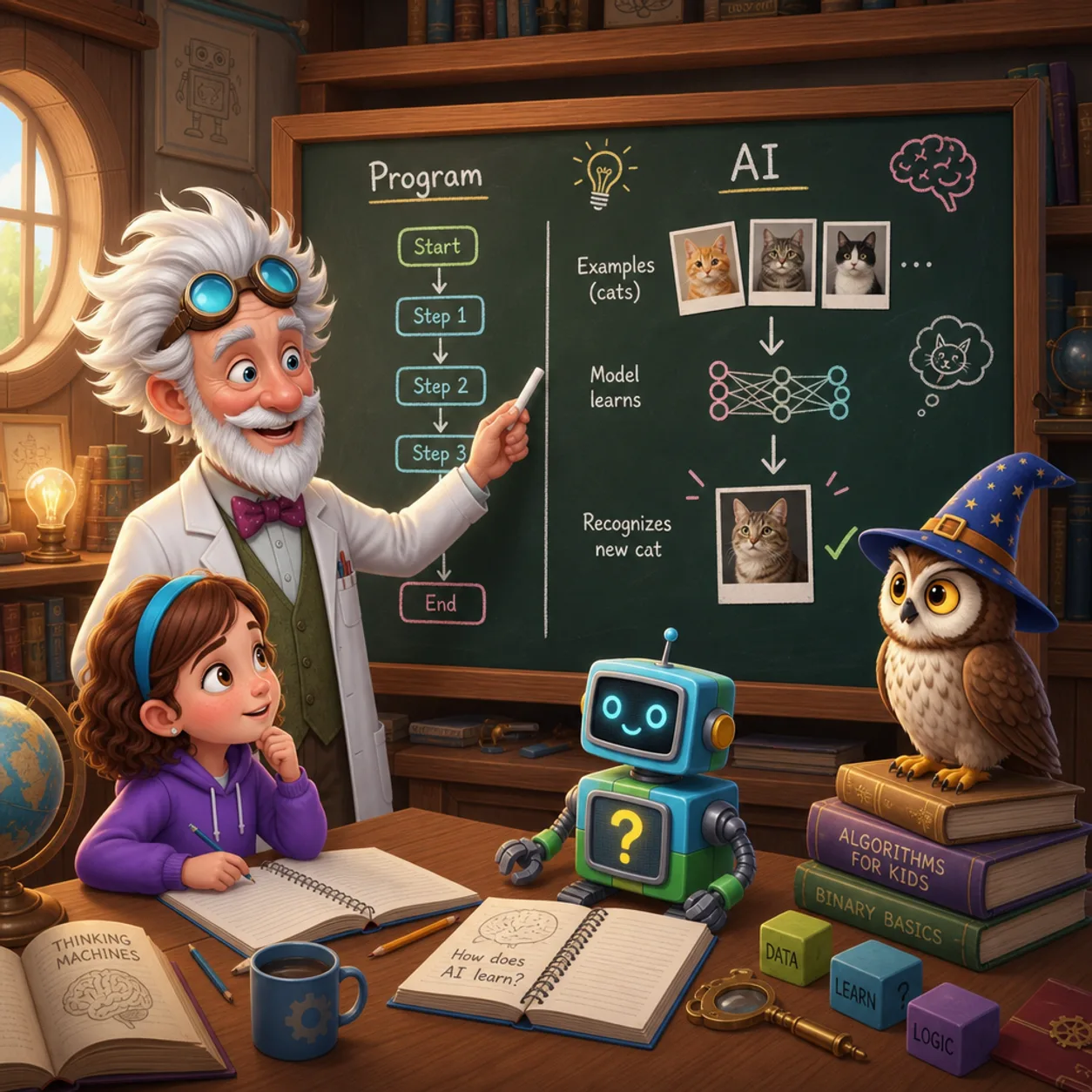
— To better understand what artificial intelligence is, let's figure out how it differs from ordinary computer programs, — the Professor suggested.
He drew a table on the board:
Ordinary Program              | Artificial Intelligence System
------------------------------|---------------------------------------
Follows rigid rules          | Can adapt and learn
Works predictably            | Can give unexpected results
Requires precise instructions| Can work with incomplete data
Doesn't change without        | Can improve independently
programmer intervention      |
— For example, a calculator is an ordinary program, — the Professor explained. — It always gives the same answer to the same problem and can't learn anything. But a facial recognition system is AI. It can improve by learning from new examples and adapt to different lighting conditions or angles.
— And how does artificial intelligence work? — Alice asked. — How does a computer learn?
— There are several main approaches, — the Professor replied. — The most common now is machine learning. In it, the computer isn't directly programmed to solve a task, but learns from examples.
Byte displayed a diagram on his screen:
Data → Learning Algorithm → Model → Predictions— Imagine we want to teach a computer to recognize cats in photos, — the Professor continued. — We show it thousands of photos labeled as "cat" or "not cat." The learning algorithm analyzes these photos and creates a model that extracts essential features of cats. Then this model can be used to recognize cats in new, previously unseen photos.
— This reminds me of how children learn, — Alice noticed. — They're shown different animals and told what they're called, and then children can recognize them themselves.
— Excellent comparison! — the Professor praised. — Although, of course, the learning process in children is much more complex and includes many aspects we can't yet reproduce in AI.
— One of the most powerful machine learning methods is deep learning using neural networks, — Logic added. — These networks consist of many layers of artificial neurons that can identify complex patterns in data.
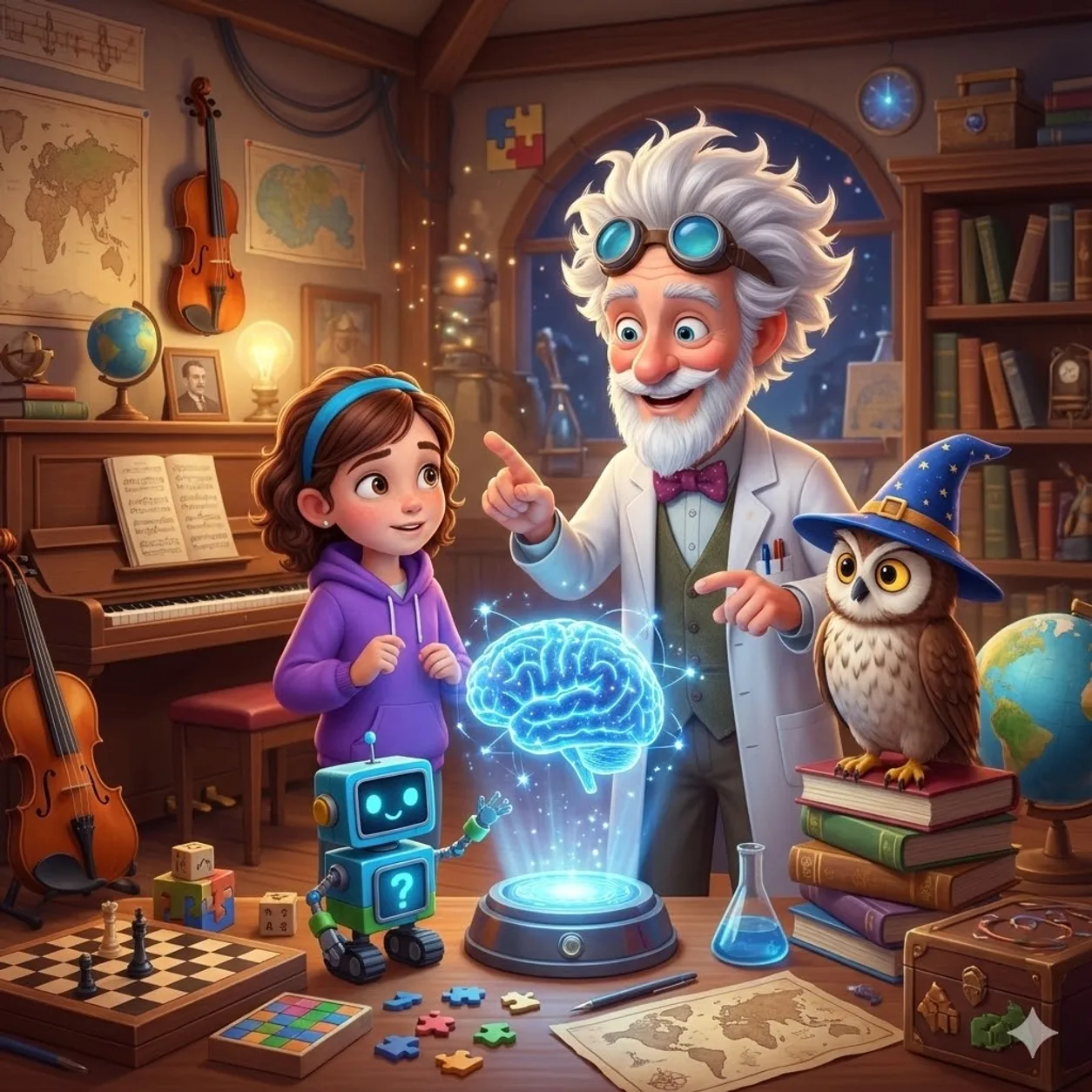
— Neural networks revolutionized areas like computer vision, natural language processing, speech recognition, — Byte confirmed. — They underlie many modern AI systems, from voice assistants to self-driving cars.
— Are there different types of artificial intelligence? — Alice wondered.
— Yes, there are several classifications, — the Professor replied. — One of them divides AI into "narrow" and "general." Narrow AI (Narrow AI) specializes in performing specific tasks and can't go beyond its specialization. For example, a system playing chess won't be able to recognize speech. All existing AI systems now belong to the narrow AI category.
— And what about general AI? — Alice asked.
— General AI (General AI) — is a hypothetical system that could perform any intellectual task no worse than a human, — Logic explained. — Such AI doesn't exist yet, and it's unknown when it might appear or if it's even possible in principle.
— They also speak of "strong" and "weak" AI, — the Professor added. — Weak AI imitates some aspects of human intelligence but doesn't possess consciousness or understanding. Strong AI theoretically could possess consciousness similar to human.
— All modern AI systems belong to weak and narrow AI, — Byte summarized. — They can be very effective in their areas, but these are still tools created to solve specific tasks, not independent thinking entities.
— And where is artificial intelligence already used in real life? — Alice asked.
— Almost everywhere! — the Professor smiled. — Here are some examples:
1. Virtual assistants — Siri, Alexa, Google Assistant use AI for speech and natural language recognition
2. Recommendation systems — Netflix, YouTube, Spotify recommend content based on your preferences
3. Search engines — Google and other search engines use AI for ranking results and understanding queries
4. Cars — from driver assistance systems to fully autonomous vehicles
5. Medicine — analyzing medical images, predicting diseases, developing medications
6. Finance — detecting fraud, algorithmic trading, creditworthiness assessment
7. Games — from chess programs to NPCs in video games
8. Smart homes — managing lighting, heating, security
9. Education — personalized learning, automatic assignment checking
10. Art — generating images, music, texts
— And what limitations does modern AI have? — Alice wondered.
— Despite all achievements, modern AI still has significant limitations, — Logic replied. — For example:
1. Lack of common sense — AI may not understand simple things obvious to people
2. Problems with causality — difficulties understanding cause-and-effect relationships
3. Data dependency — AI may reproduce biases contained in training data
4. "Black box" problem — often it's difficult to understand exactly how AI arrived at a certain decision
5. Vulnerability to deception — AI can be fooled by specially created examples
6. Difficulty transferring knowledge — skills learned in one area are hard to apply in another
— These limitations are gradually being overcome, — the Professor added. — Scientists are developing new methods that make AI more reliable, explainable, and universal.
— And what about concerns that AI might become too smart and rebel against people? — Alice asked. — I often see such plots in movies.
The Professor smiled:
— This is a popular topic in science fiction, but reality is much more complex. Serious AI researchers indeed discuss potential risks associated with developing this technology, but they're usually more grounded and specific than scenarios from movies.
— The main real problems are related to how people will use AI, — Logic added. — For example, questions of safety, privacy, fairness, impact on the job market, possible exacerbation of existing inequality.
— That's why it's so important to develop AI ethics and create systems that align with human values and are under human control, — Byte emphasized.
— Nevertheless, — the Professor noted, — the future of AI opens amazing possibilities. We're on the threshold of a new era when intelligent systems can help solve many global problems: from climate change to treating diseases.
— Artificial intelligence is a tool, — he summarized. — And like any tool, it can be used in different ways. Our task is to learn to apply it with wisdom and responsibility.
— And this is the advantage of studying programming and AI principles, — Logic added. — This gives you not only skills for a future profession but also understanding of how these technologies work, their capabilities and limitations.
— Remember that behind any technology are people, — Byte said. — Their knowledge, creativity, values. Technologies don't develop by themselves — they're created and directed by people.
— And who knows, — the Professor smiled, — maybe someday you'll create a new artificial intelligence system that helps make the world better.