
📖 Table of Contents
Part 1: The World of Programming Around Us
Part 2: The Alphabet and Vocabulary of Programming
Part 3: Building Our First Programs
Part 4: Our Amazing Brain
Part 5: Creative Projects
Part 6: Programming in the Real World
Chapter 24 of 27
7: From Electricity to AI
Chapter 24: "Electricity - The First Step to a New Era"
On one cloudy day, Professor Bit invited Alice, Byte, and Logic on an excursion to the city's science and technology museum. When they arrived at the majestic museum building, it started raining, and they had to quickly run for cover.
— Now this is what I call timely arrival, — the Professor smiled, shaking raindrops from his coat. — Today I want to show you something special — the history of how humanity tamed electricity and how it led to the creation of modern computers and artificial intelligence.
He paused for a moment and quietly read:
Электричество
Не помню точно, но когда-то,
В седые, давние года,
На всех людей после заката
Спускалась плотно темнота.
Когда-то древняя планета,
И люди, жившие на ней,
Страдали от нехватки света,
Боролись с холодом теней.
Тогда ещё не знали тока,
Тогда не ведали машин.
Вдруг небо вспыхивало строго
От ярких молний средь вершин.
Никто не знал тогда ответа,
Хоть гром спускался из небес:
Откуда в небе столько света?
В умах рождался интерес.
Они дивились этой силе,
И, чтоб во мраке не блуждать,
Природу приручить решили,
Стихии стали подражать.
Им это удалось не скоро,
Прошли столетья и года,
Но искр бушующая свора
Поймалась в сети-провода.
И был момент тот переломным,
Он стал началом новых лет.
На смену дням холодным, тёмным
Пришли прогресс, тепло и свет.
Открытий сделано немало
За время бытия людей,
Но электричество — начало…
Исток сегодняшних идей.
They entered a spacious hall with high ceilings. Along the walls were display cases with historical artifacts, and in the center — interactive exhibits demonstrating various electrical phenomena.
— The history of electricity began long before people truly understood its nature, — the Professor began, leading Alice to the first display case, where a piece of amber lay. — Even the ancient Greeks around 600 BC noticed that amber rubbed with wool attracts light objects. The word "electron" in ancient Greek means "amber."
— But millennia passed from these observations to practical use of electricity, — the Professor continued as they moved to the next exhibits. — A real breakthrough occurred in the late 18th — early 19th century when scientists began systematically studying electrical phenomena.
They stopped at a display dedicated to Alessandro Volta and his invention — the first electric battery, created in 1800.
— This was the first battery, — the Professor explained. — It consisted of alternating zinc and copper discs separated by cloth soaked in saltwater or acid. This invention made it possible to obtain a constant electric current, which opened the way for further research and inventions.
— When did electricity begin to be used practically? — Alice asked.
— The first practical applications appeared in the mid-19th century, — the Professor replied, pointing to a display with a telegraph apparatus. — The electric telegraph, invented by Samuel Morse, became the first device for quickly transmitting information over long distances. Before this, news could take days or weeks.
They moved further to exhibits dedicated to the invention of the electric light bulb.
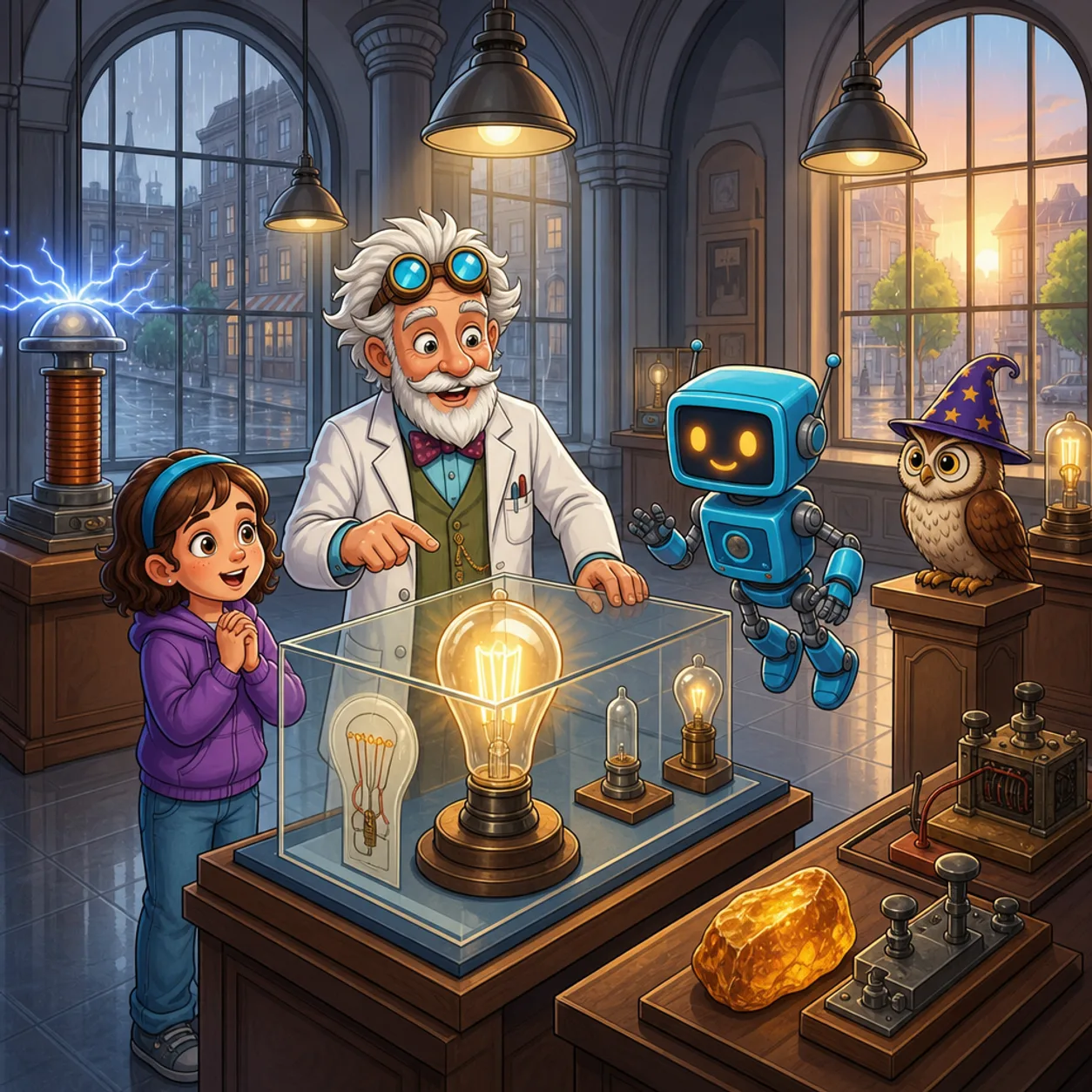
— Thomas Edison wasn't the first to invent an electric lamp, — the Professor noted. — But he created the first practical and durable incandescent lamp in 1879. And no less importantly, developed a system for producing and distributing electrical energy.
— So without Edison, we wouldn't have electricity in our homes? — Alice clarified.
— Not exactly, — the Professor smiled. — The credit for creating the modern electrical supply system belongs to many scientists and engineers. Nikola Tesla especially played an important role with his inventions in alternating current.
Byte, rolling alongside, added:
— It was thanks to alternating current that transmitting electrical energy over long distances without significant losses became possible. This revolutionized industry and everyday life.
They approached a large panel showing how electricity spread around the world.
— In the early 20th century, electrification was in full swing, — the Professor continued. — Cities were lit with electric lights, homes began to have electric lamps and the first household appliances, factories switched from steam engines to electric motors.
— Electricity changed everything, — Logic emphasized. — It made possible new types of production, transportation, communication, medicine, entertainment. But perhaps its most revolutionary application is the foundation for creating computers and, ultimately, artificial intelligence.
They moved to the next hall, dedicated to early computing devices.
— But before we talk about computers, let's think about why electricity became such a turning point in human history, — the Professor suggested. — What's so special about it?
Alice thought:
— Maybe that it allows transmitting energy and information almost instantly?
— Excellent observation! — the Professor praised. — Exactly the speed and flexibility of electricity make it unique. Electrical signals propagate at speeds close to the speed of light. And electricity easily converts into other forms of energy: light, heat, motion, sound. And, critically important for computers, electrical signals can be controlled with high precision.
— Electricity became the bridge that connected the physical world with the world of information, — Logic added. — It made possible encoding, transmitting, storing, and processing information with unprecedented speed and efficiency.
The Professor led Alice to a display case with early electronic components — vacuum tubes.
— Here they are — the first electronic switches, — he said. — Vacuum tubes could control electron flow and thus represent binary information: on or off, 1 or 0. This became the basis for creating the first electronic computers in the 1940s.
— But these tubes were large, consumed a lot of energy, and often burned out, — Byte added. — A real breakthrough occurred with the invention of the transistor in 1947.
They moved to an exhibit dedicated to transistors and integrated circuits.
— A transistor is a semiconductor device that performs the same switching functions as a vacuum tube, but it's much smaller, more reliable, and energy-efficient, — the Professor explained. — And in 1958, Jack Kilby and Robert Noyce independently invented the integrated circuit or microchip — a device containing many transistors on a single silicon substrate.
— And since then, microchips have become smaller and more powerful, — Byte continued. — In 1965, Gordon Moore noticed that the number of transistors on a microchip doubles approximately every 18-24 months. This observation became known as Moore's Law and remarkably accurately described the development of computer technology for decades.
— So without electricity, there would be no computers? — Alice asked.
— In the form we know them now — definitely not, — the Professor nodded. — Although theoretically mechanical or optical computers are possible, they would be much slower and less practical.
They moved to a display showing the connection between the work of the human brain and computers.
— There's an amazing parallel between electrical signals in computers and in our brain, — the Professor noted. — Neurons — brain cells — communicate using electrochemical signals. Of course, the brain is much more complex than any computer, but the basic principle of transmitting information through electrical impulses is similar.
— This parallel inspired the creation of artificial neural networks — the foundation of modern artificial intelligence, — Logic added. — They mimic the work of brain neurons, though very simplified.
They reached the last exhibit, dedicated to modern technologies and prospects for their development.
— Electricity opened the door to a new era, — the Professor summarized. — From the first observations of static electricity to supercomputers and artificial intelligence — this is a journey of millennia, but the main progress happened in the last 200 years, which in the scale of human history is an instant.
— And we're only at the beginning of this path, — Byte added. — Technologies continue to develop exponentially. What seemed like science fiction ten years ago is becoming reality today.
When they left the museum, the rain had stopped, and the sun peeked through gaps in the clouds.
— You know, Alice, — the Professor said as they walked to the car, — I told you this story not just for interesting facts. It's important to understand that great technological breakthroughs don't happen overnight. They're built on the foundation of previous discoveries, on the work of many scientists and engineers, on the gradual accumulation of knowledge and overcoming obstacles.
— And who knows, — Logic added, — maybe you'll become part of the next great breakthrough. Perhaps your ideas and inventions will open a new chapter in the history of technology.
Alice nodded thoughtfully, imagining what amazing possibilities the future might bring and what role she herself could play in creating it.