
📖 Table of Contents
Part 1: The World of Programming Around Us
Part 2: The Alphabet and Vocabulary of Programming
Part 3: Building Our First Programs
Part 4: Our Amazing Brain
Part 5: Creative Projects
Part 6: Programming in the Real World
Chapter 23 of 27
6: Programming in the Real World
Chapter 23: "Your Journey is Just Beginning"
On one sunny spring day, Professor Bit invited Alice, Byte, and Logic to a picnic in the park. After several months of studying programming, it was time to summarize some results and outline the further path.
They settled on a cozy clearing with a view of the lake. The Professor spread out a blanket and took out a thermos with tea and a basket with sandwiches and fruit.
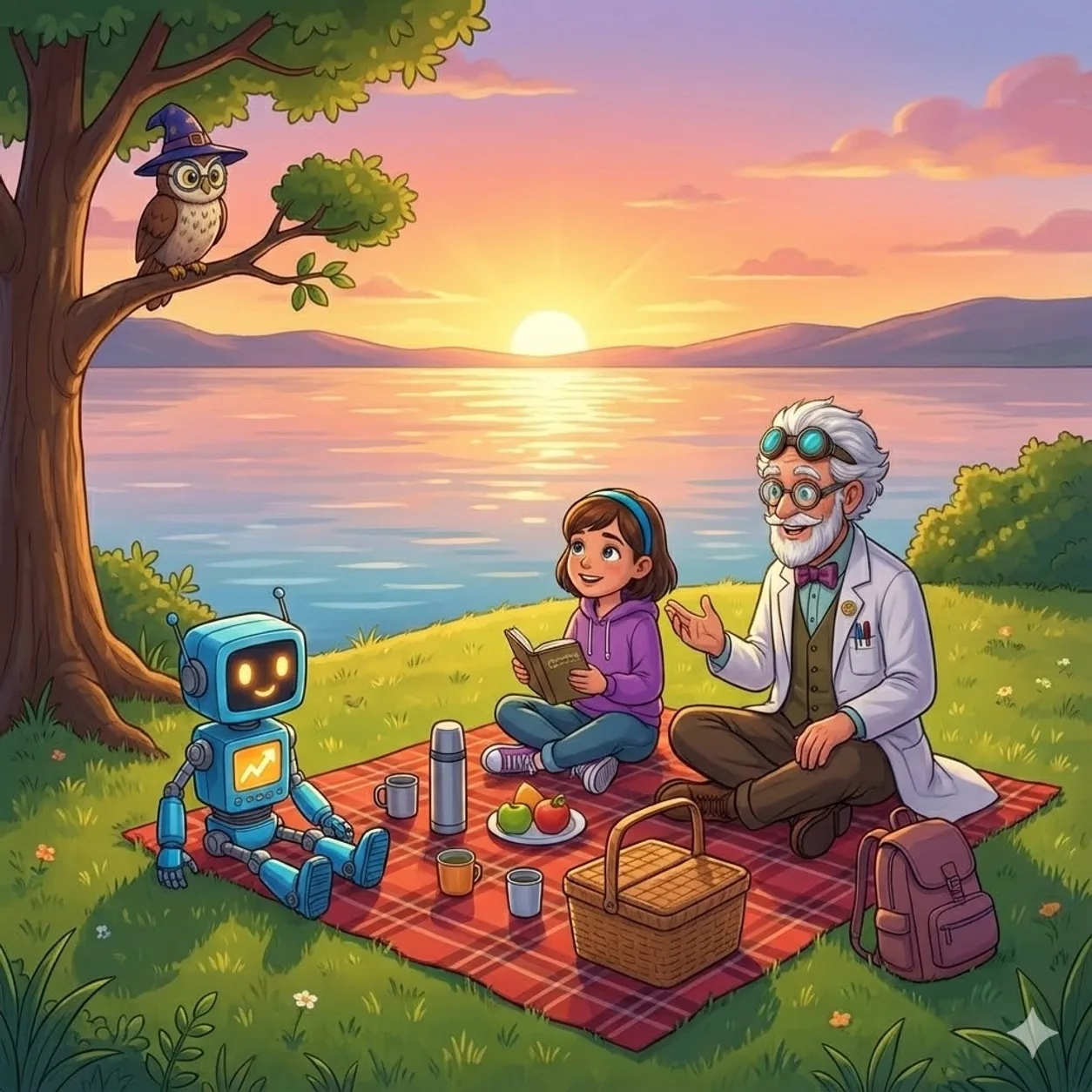
— Alice, you've come a long way recently, — the Professor smiled, pouring tea into cups. — From your first steps in the world of programming to creating your own projects. What do you think you've learned the most?
Alice thought, looking at the sun's reflections on the water:
— You know, Professor, I realized that programming isn't just writing code. It's a way of thinking, solving problems. Even when I'm not at the computer, I now look at the world differently — I see algorithms around, notice data structures, understand how processes can be optimized.
She quietly added:
Мир перестал быть хаотичным,
Он обретает ясный строй.
И то, что виделось обычным,
Связалось логикой одной.
В листве деревьев — графов ветви,
В теченье рек — массивы вод.
И кажется, на всё ответит
Изящный, лаконичный код.
Здесь нет финала у познанья,
Решённый баг — лишь первый шаг.
Открыто целое призванье,
Где ты творец, а не чужак.
— Excellent observation! — the Professor praised. — Programming really forms a special mindset. It's like a new language that allows you not only to communicate with computers but to see the world in a new way.
Byte joyfully jumped:
— And the most wonderful thing is that this path never ends! There are always new languages, technologies, approaches, areas of application. Programming constantly evolves.
— That's exactly why I wanted to talk today about what's next, — the Professor nodded. — Your journey is just beginning, and you have many roads ahead.
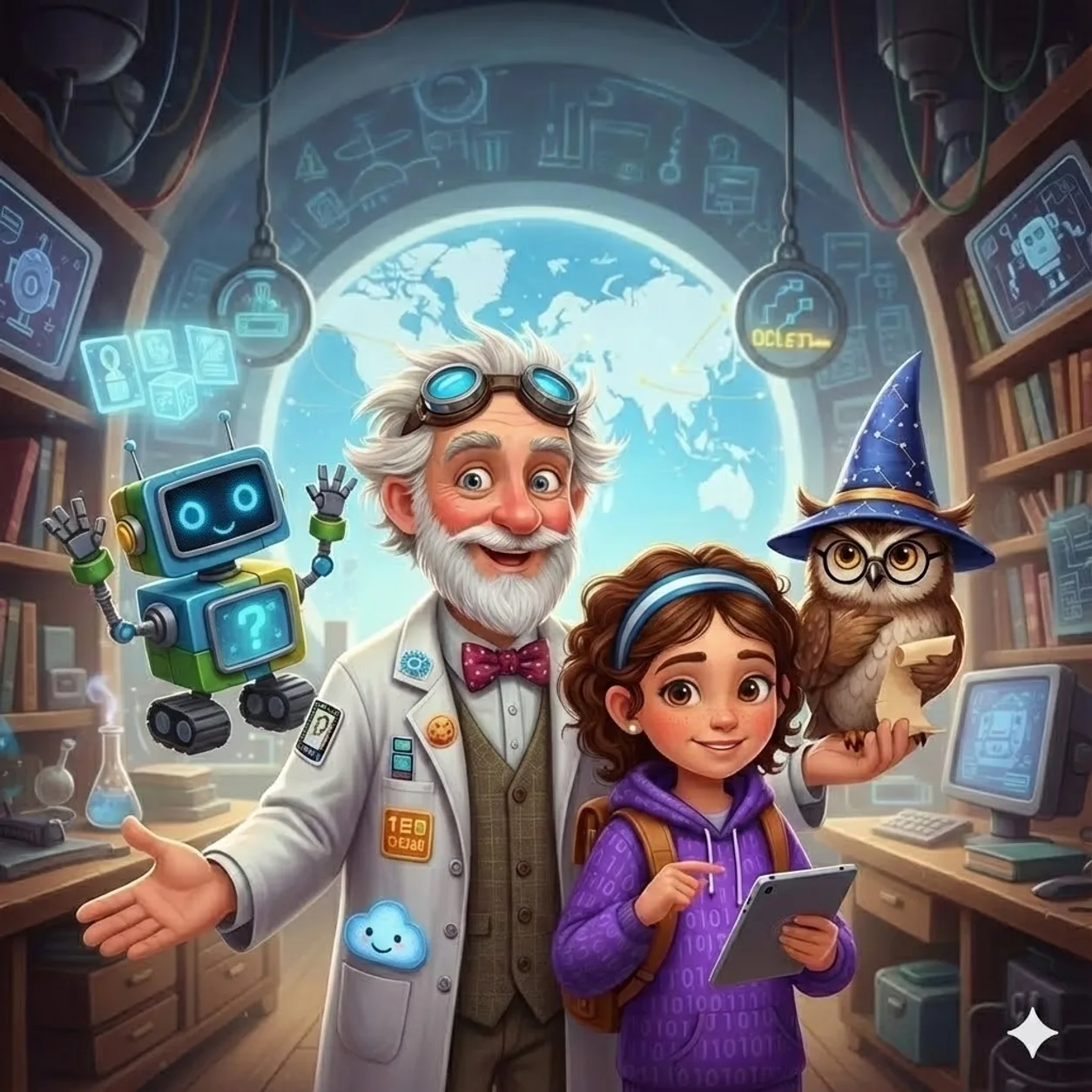
Logic spread her wings:
— It's important to understand that mastery in programming comes with practice. The more code you write, the more real problems you solve, the better you become.
— What ways are there to continue learning? — Alice asked, taking a notebook from her backpack.
— There are many, — the Professor smiled and began listing:
1. Online courses and video lessons
- Platforms like Coursera, edX, Udemy offer courses from beginner to advanced levels
- YouTube channels with programming lessons
- Interactive platforms like CodeAcademy, LeetCode, HackerRank for practice
2. Books and documentation
- Classic books on programming and computer science
- Official documentation for languages and libraries
- Developer blogs and technical articles
3. Open source projects
- Studying code from successful projects
- Contributing to existing projects, even small contributions
- Creating and publishing your own projects
4. Competitions and hackathons
- Participating in programming competitions
- Hackathons where you need to create a project in limited time
- Computer science olympiads for schoolchildren
5. Communities and groups
- Local programmer meetings
- Online forums and chats (Stack Overflow, Reddit, Discord)
- Programming and technology conferences
— What about formal education? — Alice wondered. — Do you need to enroll in computer science programs?
— Good question, — the Professor nodded. — Formal education provides structured knowledge and a fundamental theoretical base. This is especially important in areas like algorithms, data structures, computer architecture, theory of computation.
— But there are many successful self-taught programmers, — he added. — The main thing is to constantly learn and practice, regardless of the formal path.
— How to choose what to focus on? — Alice asked. — There are so many languages, technologies, areas!
— At early stages, it's important to get a broad overview, — Logic advised. — Try different languages, developing different types of applications. This will help find what truly interests you.
— I agree, — the Professor nodded. — At the same time, it's useful to deeply master one programming language before moving to the next. This will allow better understanding of the principles underlying all languages.
— And it's also important to solve real problems, — Byte added. — Create projects that interest or are useful to you. The best way to learn is to do something concrete.
The Professor took a small book from his bag:
— I've compiled a list of resources and ideas for further learning for you. Here are recommendations for books, courses, websites, as well as project ideas of varying difficulty.
Alice gratefully accepted the book and began flipping through it.
— Professor, what projects could be suitable for a beginning programmer? — she asked.
— There are many ideas of varying difficulty, — the Professor replied. — Here are some of them:
For beginners:
For intermediate level:
For advanced level:
— It's important to choose projects that interest you, — the Professor emphasized. — This way you'll be motivated to finish them and overcome difficulties that will inevitably arise.
— What are the main difficulties waiting on the learning path? — Alice asked.
— Oh, there are quite a few, — the Professor smiled. — But forewarned is forearmed. Here are some typical challenges:
1. Feeling overwhelmed by information
- Solution: focus on one topic at a time, break learning into small steps
2. Technical difficulties and errors
- Solution: view them as part of the learning process, develop debugging skills
3. "Plateau" state, when progress seems to have stopped
- Solution: try new tasks, projects, learning approaches
4. Impostor syndrome (feeling you're not good enough)
- Solution: remember everyone started from zero, compare yourself only to yesterday's you
5. Rapid technology changes
- Solution: focus on fundamental concepts that change more slowly
Logic, who flew to a nearby branch, added:
— It's very important to find a balance between breadth and depth of knowledge. You need to broadly understand the programming ecosystem, but also have deep knowledge in several key areas.
— Are there any universal tips? — Alice asked.
— Yes, there are principles that work regardless of which programming area you choose, — the Professor nodded:
1. Break complex tasks into small steps
- Big problems are solved in parts
2. Practice regularly
- Even 30 minutes of coding every day is better than 8 hours once a week
3. Study other people's code
- Read source code from good projects, learn from experienced developers
4. Explain concepts to others
- If you can explain something in simple words, you truly understand it
5. Don't be afraid to make mistakes
- They're a necessary part of learning
6. Develop "computational thinking"
- The ability to break problems into parts, find patterns, think in abstractions
7. Collaborate with others
- Programming is often teamwork
— And perhaps most importantly, — the Professor added with a smile, — maintain curiosity and joy from creating new things. Programming is creativity, and it should bring pleasure.
— How to avoid burnout? — Alice asked. — I've heard many programmers face this.
— Excellent question, — the Professor nodded. — Burnout is a real problem. Here are some tips:
1. Take breaks
- Regularly step away from the computer, give your brain a rest
2. Alternate projects and tasks
- Switch between different types of work
3. Set realistic expectations
- Don't try to learn everything at once or create a perfect project on the first try
4. Celebrate small victories
- Mark your progress, even if it's small achievements
5. Take care of physical health
- Sleep, nutrition, physical activity directly affect cognitive abilities
6. Find inspiration
- Connect with like-minded people, attend conferences, read success stories
Byte rolled closer and displayed a bright message on his screen: "And remember — you can always ask for help!"
— Exactly, — the Professor confirmed. — The programming community is very friendly and always ready to help. Don't hesitate to ask questions on forums, in chats, or turn to more experienced developers.
— How to stay updated on all new technologies? — Alice asked. — So many appear!
— You don't need to try to follow everything, — Logic shook her head. — Choose several reliable information sources: blogs, podcasts, YouTube channels, newsletters on topics that interest you. Technology news can be reviewed once a week, not constantly.
— And remember, — the Professor added, — not all new technologies catch on. Sometimes it's better to wait until the situation clarifies before investing time in learning a new technology.
The sun began to set, coloring the sky and lake in golden and pink tones. Alice looked into the distance, thinking about her path in programming.
— You know, — she finally said, — when I just started, I thought programming was just a set of technical skills. But now I understand it's much more. It's a way of thinking, creativity, problem-solving. It's an opportunity to create things that can change people's lives for the better.
The Professor smiled:
— Exactly so. And whatever you choose in the future — whether you become a professional developer or use programming as an additional skill in another profession — this knowledge and this way of thinking will stay with you forever.
— Remember that technologies are just tools, — Logic noted. — What matters is what you use them for, what problems you solve, what value you create.
— And don't forget to have fun in the process! — Byte winked. — Programming should bring joy.
— Your journey is just beginning, — the Professor said, looking at the sunset. — And I'm sure it will be amazing.
They sat by the lake for a long time, discussing project ideas, dreaming about the future, and enjoying the warm spring evening. This wasn't an end, but just a new stage in the endless journey of knowledge.
Task
1. What languages or technologies you want to learn or deepen
2. What resources you'll use (books, courses, websites)
3. Projects you would like to implement
4. How often you plan to study and how much time to dedicate
5. How you'll track your progress
6. How you'll celebrate your successes and motivate yourself