
📖 Table of Contents
Part 1: The World of Programming Around Us
Part 2: The Alphabet and Vocabulary of Programming
Part 3: Building Our First Programs
Part 4: Our Amazing Brain
Part 5: Creative Projects
Part 6: Programming in the Real World
Chapter 4 of 27
1: The World of Programming Around Us
Chapter 4: "Computers — Our Smart Helpers"
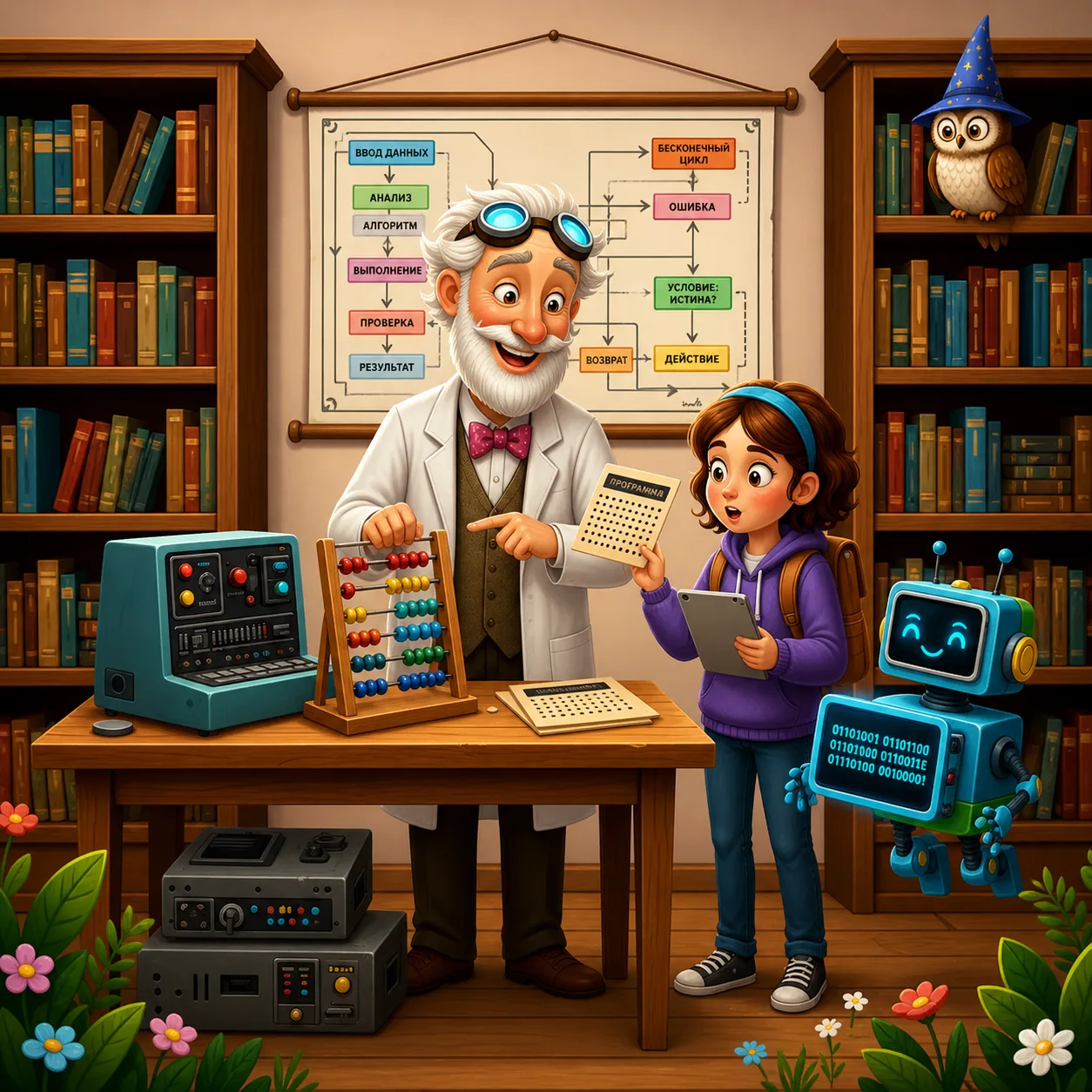
The next day, Alice came to Professor Bit's laboratory. In the middle of the room stood an old wooden table, and on it — strange devices of different sizes and shapes.
— Welcome to the computing museum! — announced the Professor, making a wide gesture with his hand. — Today we'll learn how people taught machines to think and execute programs.
Byte proudly rolled between the exhibits:
— This is my family history!
Alice approached a strange object that looked like a frame with beads.
— What is this?
— This is an abacus — one of the first calculators, — the Professor explained. — People moved these beads to add and subtract numbers. It's the simplest computing tool, but the principle is the same as in modern computers — processing data according to certain rules.
Logic flew down from a bookshelf:
— A computer is a machine that can store information, process it according to given rules, and output the result.
— How is a computer different from a calculator? — Alice asked, moving to the next exhibit.
— A computer is much smarter, — the Professor replied. — It can not only perform mathematical operations, but also store data, make decisions based on conditions, and control other devices.
The Professor pointed to a glass display case where an old punched card lay:
— Look at this. Programs used to be written on such cards with holes. Each hole is an instruction for the computer.
— Like Morse code? — Alice guessed.
— Similar! — the Professor nodded. — Computers understand only two symbols: 1 and 0, or "signal present" and "no signal." This is called binary code or binary language.
Byte extended a small screen from his body, showing lines of ones and zeros:
— 01001000 01100101 01101100 01101100 01101111 00100001
— What did he say? — Alice asked.
— "Hello!" — translated the Professor. — Each letter in a computer is represented by its own unique set of zeros and ones.
Всего два знака, два пути,
Чтоб лабиринт насквозь пройти.
Банально просто — Да и Нет,
И так рождается сюжет.
Песок, расплавленный в кристалл,
Вместилищем для смысла стал.
Сокрыта логика в металл,
Чтоб чистый свет её читал.
А за пределами систем,
Лежит порядок микросхем.
Есть ноль — молчание и мрак,
И единица — свет и знак.
Блестит слоистая слюда
Из комбинаций «Нет» и «Да»,
Между «всегда» и «никогда»
Родится и умрёт звезда!
— But if computers only understand zeros and ones, how can we write programs for them in a regular language? — Alice wondered.
— Excellent question! — The Professor led Alice to a large diagram on the wall. — Look, programs work at different levels. At the bottom — machine code, understandable only to the computer's processor. Higher up — programming languages, which are understandable to people. Between them — translator programs.
— Like Google Translate? — Alice asked.
— In a way, yes! — the Professor smiled. — When you write a program in Python or Scratch, a special translator program turns your code into instructions that the computer understands.
Logic added:
— Imagine you're talking to a person who only knows Chinese. You need a translator. Similarly, a computer needs a translator to understand human programming languages.
— What's inside a computer? How does it work? — Alice pointed to an open computer case on the table.
— Look, — the Professor pointed to a green board with many small parts. — This is the motherboard — the main part of the computer. On it sits the processor — the brain of the computer. It performs all calculations and processes all data.
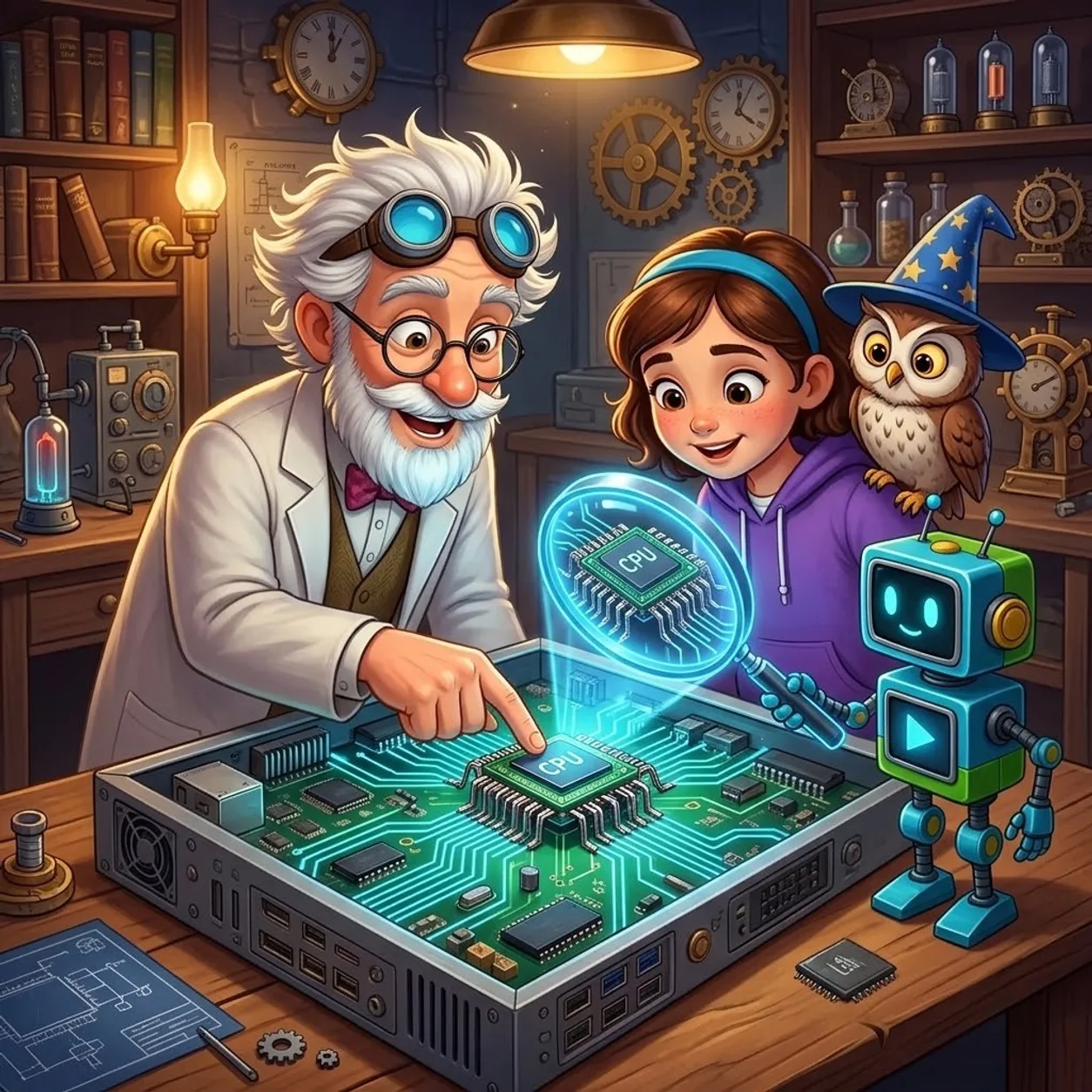
— Like a calculator?
— Much more powerful! A modern processor performs billions of operations per second. Next to it is memory, where programs and data are stored.
Byte proudly tapped himself on the chest:
— I also have a processor and memory inside!
— Exactly, Byte, — the Professor nodded. — Now, Alice, look: when you launch a game on a computer, here's what happens inside:
1. The game program loads from storage into memory
2. The processor reads instructions from the program and executes them
3. The graphics processor creates images on the screen
4. The sound card reproduces sounds
5. Input devices (keyboard, mouse) transmit your commands to the processor
— And all this happens so fast that we don't even notice! — Alice exclaimed.
— Right! A computer works at incredible speed, executing millions of instructions every second, — the Professor confirmed.
Alice pointed to a small part with many legs:
— What is this strange beetle?
— This is a microprocessor, — the Professor smiled. — This tiny part contains billions of transistors — microscopic switches that can be either on (1) or off (0). They create that binary code we talked about.
— It's incredible that such a small thing can be so smart! — Alice was amazed.
— Actually, — Logic noted, — computers aren't smart on their own. They just execute instructions very quickly and accurately that humans give them.
— Exactly! — the Professor continued. — A computer is a tool, like a hammer or pencil. It only becomes useful in the hands of a person who knows how to use it. That's why it's so important to learn programming — it helps us use all the power of computers to solve the most diverse tasks.
— I want to learn how to control computers! — Alice declared decisively.
— And you definitely will! — the Professor winked. — We've already started this journey.